

The pieces are all there. Some of them are properly assembled. Others (perhaps most) need further polishing for the whole thing to come together. Still, something pulsates about Darkling, a play that depicts the struggles of a disadvantaged Indian girl born into strict cultural traditions, culminating in the infamous Bhopal disaster that changed and, in some ways, destroyed everyone.
Author Titas Halder delivers an interesting approach, focusing on the character’s backstory rather than the incident’s aftermath. Viewers are taken on a journey spanning over a decade, as the protagonist grows to understand her place in society — but also the possibilities of breaking away from a life she never asked for: her mother doesn’t want her children to resign themselves to poverty, and her sister isn’t willing to accept an arranged marriage to a man who doesn’t treat her kindly.
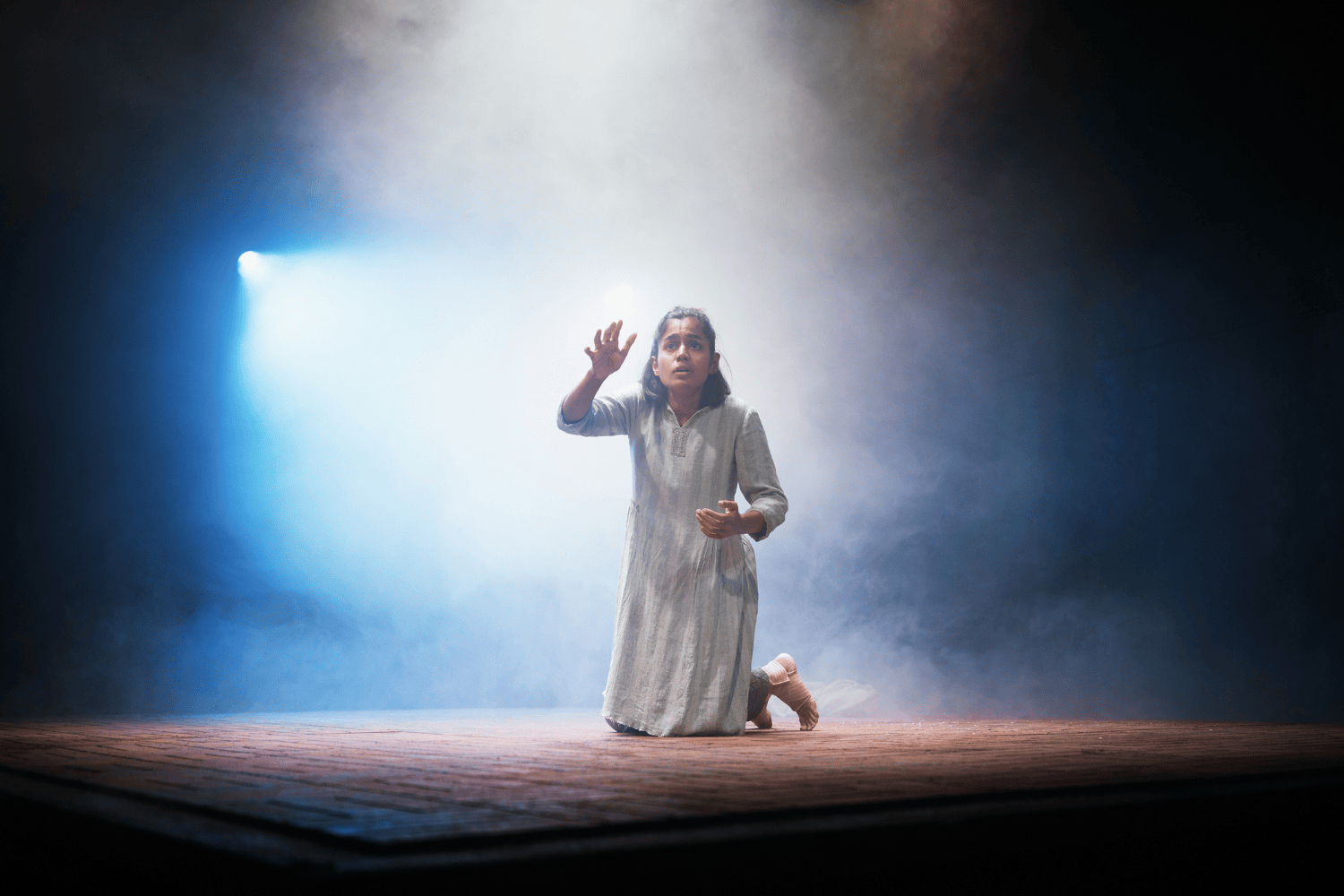
Themes of self-discovery and nonconformity become the show’s heart and soul, which are adequately explored on a philosophical level. The problem lies in its dramaturgical execution, which isn’t as deft or engaging. Although the plot’s events are enticing and meaningful, their overall display has no grip. Some sections are slightly pedestrian. And despite covering so many poignant topics (such as young, forbidden love and the personage’s conflicted relationship with her father), the pathos is very weak — and usually nonexistent.
Ultimately, the script has all the ingredients to create a compelling narrative. However, it doesn’t employ the best techniques. Some segments feature overly long monologues that feel more distracting than profound. In addition, the scarce dialogue makes the pacing sluggish and the general experience overwhelmingly dull. The result is a lack of emotional bond. We might care about what happens (how could we not after watching people bleed through their eyes?), but it’s hardly stirring.
The production’s design is a far stronger element. Credited to Simon Kenny, the staging consists of a paver floor surrounded by sand. A concrete-patterned gauze conceals a scaffolding, whose silhouette is sometimes revealed as a constant reminder of the ominous fate the protagonist and her people will ultimately endure. Occasionally, some props are repurposed to evoke a different reality. It’s functional, seamless, and dynamic. And above all, it’s highly competent.

Linnea Berthelsen’s portrayal is decent but not exceptional. She captures the most vulnerable aspects of her role. However, her rendition isn’t deep, magnetic, or even resourceful enough — showing errors typical of a neophyte actor rather than an established one. Her range is limited, conveying little nuance and remaining one-note for the most part. She is endearing, but not electric. And definitely not captivating.
It is a promising play — with a remarkable story in the rough. There’s so much potential in Darkling, and some of it has already surfaced. But it’s a long way before the piece goes from average (and fairly unmemorable) to a piercing, resonant jaunt that audiences are haunted by. It’s the kind of work that deserves a space onstage. A work that’s still waiting to be made.
Help us continue our work
We count on your support to keep bringing the greatest quality in theatre-related content, from interviews with the biggest names in the industry to reviews of every show in town and beyond.
We appreciate every donation to maintain our high pace and standards and continue to grow.
Thank you for believing in us!
***************************************************
Darkling plays at London’s Bush Theatre until 24 October ahead of its UK tour. Tickets are available on the following link.