
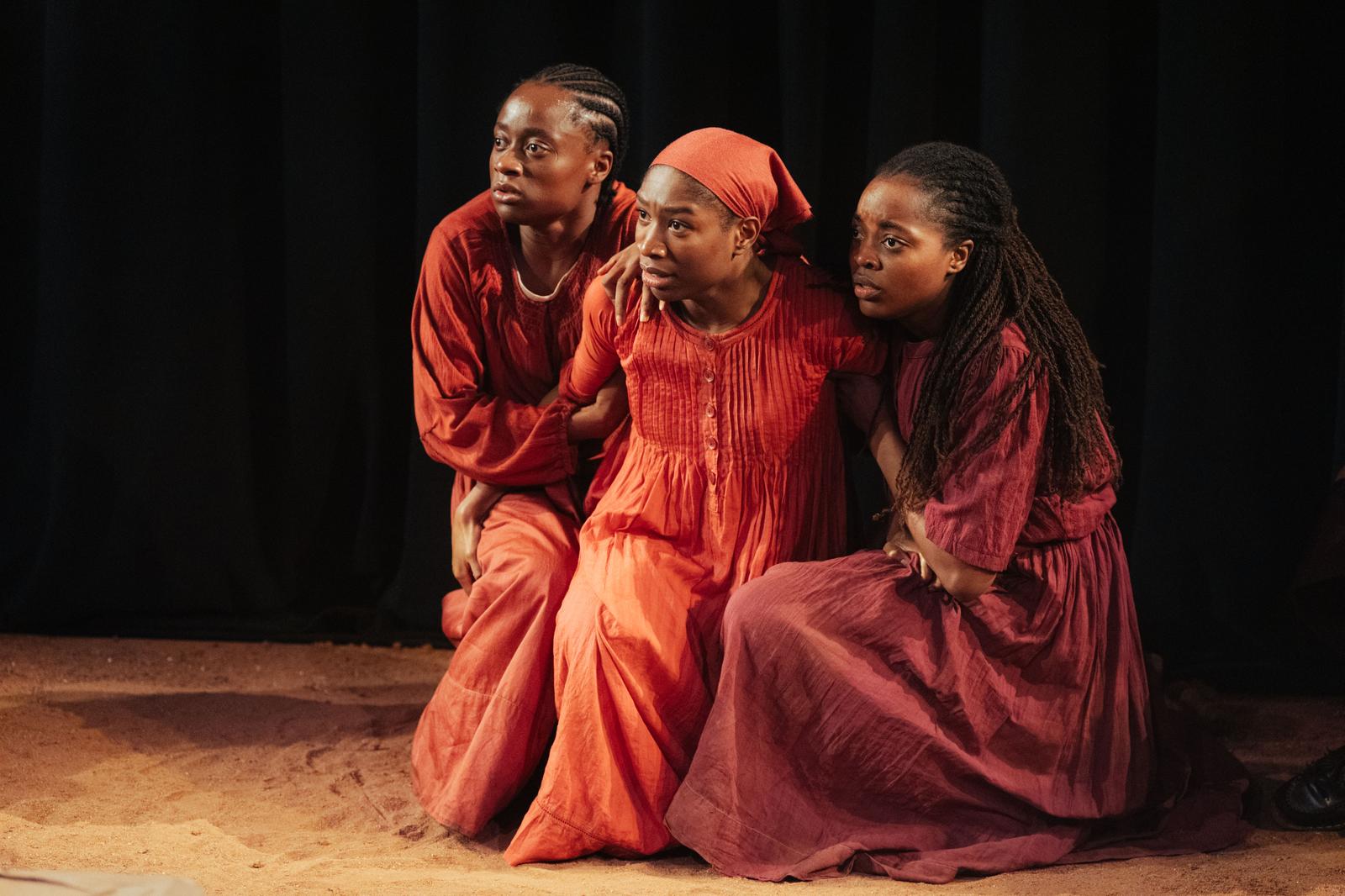
They’ve got the right premise. They delivered the right approach. But they haven’t followed through. Not completely, that is. Girls has returned to the London stage ten years after its original iteration. Its first production came at a time when its real-life inspiration was still fresh in audiences’ minds: nearly three hundred girls were kidnapped from their school dormitories in Chibok, Nigeria, by a jihadist militia group and subsequently subjected to human trafficking and sexual violence.
Theresa Ikoko’s play vividly depicts the horrific aftermath of that incident, not through graphic pictures, but through the powerful images the characters’ comments conjure in our minds. Held in a terrorist camp, the girls have seen the dead bodies of hundreds of insurrectionists piled up outside like disposable waste; they’ve come across motherless toddlers left to their own fate; and they’ve witnessed the consequences of not submitting themselves to Ala, some of them in their own skin.

The extreme situations they endure make an excellent premise for a plot about friendship, growth, and resilience. These are all themes the script tackles to some degree. Whether that degree is compelling enough is up for debate. And chances are the consensus will not reach a satisfactory conclusion. At least, not for the author. It is not bad, but it isn’t brilliant. Eventually, a sense of unfulfillment lurks around. And the only way to resolve it is to expand what actually matters and cut down on its superfluousness, which isn’t particularly restricted.
Tisana, Haleena and Ruhab are very different people. Or so we are supposed to believe. While Haleena is upfront and uncompromising, Tisana is obsessed with obeying her parents and honouring their faith, something Ruhab doesn’t want to comply with. Those are perfectly valid traits for a three-hander narrative: they lay a solid foundation for each personage while giving them the tools to complement and create friction with each other.
The issue arises when the characters have nothing else to offer: what seemed like a promising start becomes a dead-end feature that reduces the roles to mere beyond-archetypal sketches. There’s not sufficient complexity in them. And arguing that this is due to their young age would just be an easy way out of an ultimately inescapable dramaturgical flaw. The separate arcs they go through are well-established, but it feels superficial given the protagonists’ somewhat vapidness.

The structure is slightly confusing, too. Not in terms of understanding, but of tone and execution. Many harrowing segments are followed by campy sequences showing the characters fooling around. Sometimes, it’s a political impersonation involving some thought-provoking satire. Some other times, it’s their way of coping with the grief and desperation they are invaded by. It’s the latter that comes off as problematic. Not because of its purpose, but because of how they are inserted: instead of boosting the pathos, they have the opposite effect. And as we get closer to the conclusion, the piece’s overall impact is inevitably jeopardised.
The performances are remarkably good, nonetheless. The trio brims with rapport, endearment, and magnetism, resulting in a deeply engaging, committed, and moving group effort. Despite this unbreakable sense of togetherness, their portrayals are given enough space to shine on their own. In that regard, Tara Tijani earns the highest praise as Haleema, whose galvanising presence, emotional drive, and inviting tongue-in-cheekness turn her interpretation into a melting pot of gravitas and potency.
It’s the sort of drama no heart can resist. Yet, we are far from inundated with poignancy. Girls sets up the right path for the story it tries to tell without leaving any indispensable elements out of the equation. However, its excessive use of misplaced comedy and incomplete exploration of pivotal topics undermines the play’s grip and influence. It’s a subject worth discussing. The show, maybe not so much.
Help us continue our work
We count on your support to keep bringing the greatest quality in theatre-related content, from interviews with the biggest names in the industry to reviews of every show in town and beyond.
We appreciate every donation to maintain our high pace and standards and continue to grow.
Thank you for believing in us!
***************************************************
All pictures credit to Helen Murray.
The Girls plays at London’s Young Vic until 21 November. Tickets are available on the following link.