
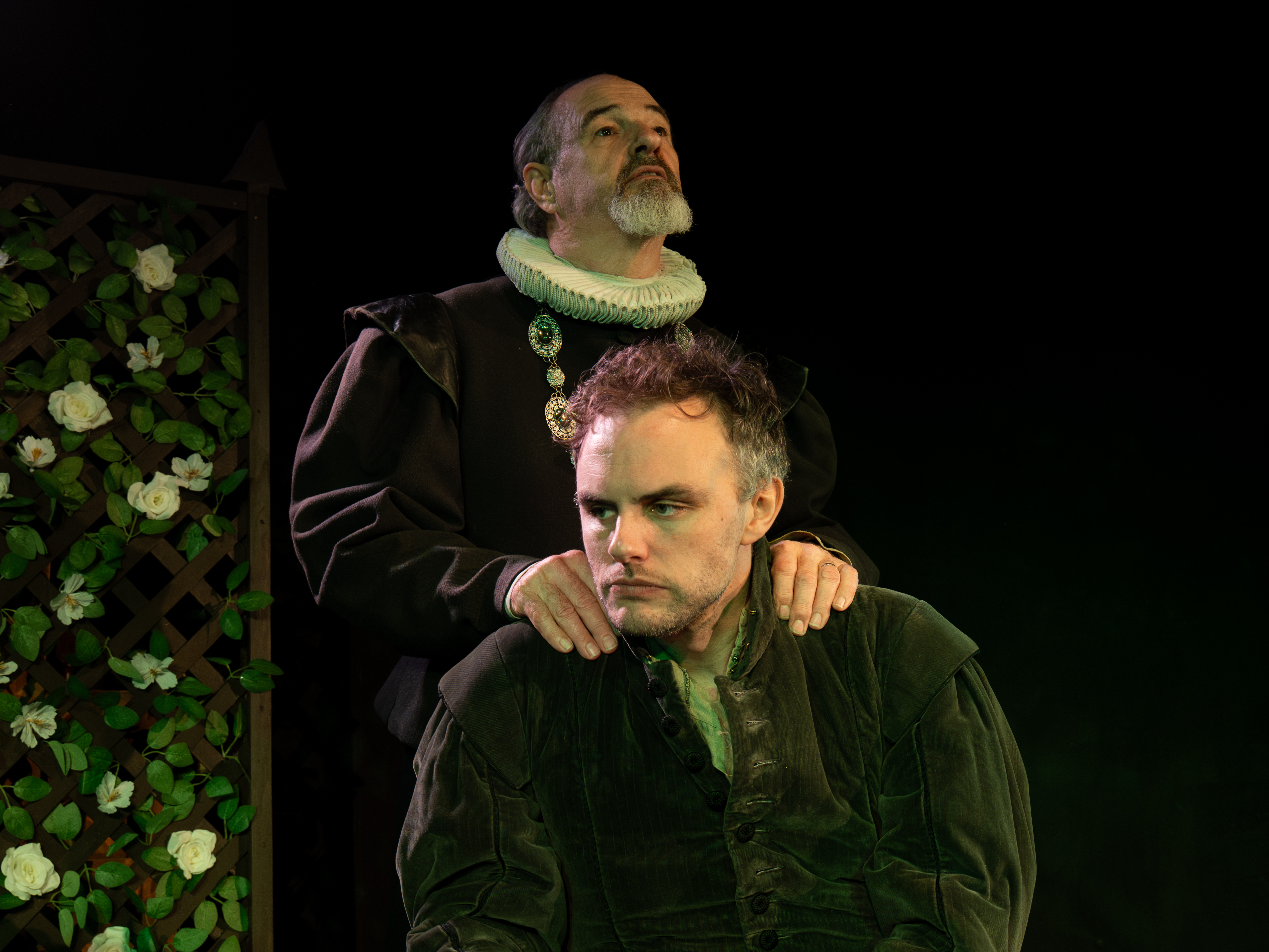
It’s always tricky to tamper with the classics, whether that be the work or the authors themselves. Two years after Lolita Chakrabarti’s pedestrian adaptation of Hamnet made it to the West End stage and immersed audiences in dramaturgical apathy, London’s fringe scene has responded with the world premiere of Shakespeare’s Cousin, a new play by Jonathan Moore depicting a fabricated encounter between Catholic martyr Robert Southwell and his most famous relative days before the latter faces capital punishment.
I can’t say the idea didn’t tickle my fancy. On the one hand, it features a fictionalised version of one of the greatest wordsmiths who ever lived (if not the greatest). On the other hand, it’s two men (sometimes three) in a dungeon — admittedly irresistible. But after all these years of working as a critic, it seems I haven’t learned to be cynical enough, despite the many disillusionments theatre has dealt me. I had fairly high expectations for this one. And most of them weren’t met.
A robed man by the name of Sir Oliver steps into Southwell’s cell disguised as his torturer’s accomplice. The revelation of his true identity is as surprising as the rest of the script (no clarifications needed). Despite enduring the severity of Topcliffe’s inquisition (including the infamous manacles), Southwell is instantly recovered by his cousin’s visit (and by the divine grace — of clumsy narrative logic). The scene fades out, working as a cliffhanger into Act Two, whose predecessor has delivered next to no action and overflowing streams of clunky exposition.

Be that as it may, a speck of promise and hope pervades its premise. It can’t save it, but it might improve what it’s been offered so far. It doesn’t. As much as we can appreciate Moore’s efforts to engage in philosophical exploration, the piece ultimately comes across as pretentious, masking its poor narrative development with relentlessly verbose spiels that, when dissected, show no depth.
Before Sir Oliver confides in his kinsman about his loss of religious faith and artistic self-belief, audiences are subjected to two interminable scenes dealing with Topcliffe’s brutal methods of interrogation. A day in the countryside doesn’t persuade Southewell, a Jesuit priest, to forsake his vow. Consequently, he is sent to the Tower of London for a more thorough cross-examination, where Topcliffe warns him of the consequences of not speaking out — in a speech so refined it could figure in the Batman series (the Adam West era).
If such unbearable stagnation didn’t put us through enough penitence, the second half regales us with an excruciating display of artificiality. Although some sections are intellectually enticing, the dialogue overall feels forced, shallow, and predictable. It introduces a few interesting themes, but it doesn’t delve into them in a way that’s dramatically compelling.
The same applies to the characters’ arcs, which are practically nonexistent. They stay exactly where they are: Topcliffe as a cartoonish villain and Southwell as a stilted foil. Sir Oliver makes the only exception, but it isn’t a good one. His intense spiritual discussions with Southwell inspire him to resume his promising career and find his true voice. And although that sounds like a satisfactory resolution, the show’s misdirection (focusing on the wrong personages for an entire act) eliminates the necessary sense of journey.

Eventually, all that’s left is a pile of banal aphorisms about artistic rightousness that take the viewer nowhere while doing very little to keep them hooked. The fact that Southwell and Oliver’s conversation is plagued with painfully unnatural lines only exacerbates its insipidness. There are just so many times you can hear the phrase “you are a genius” in a play starring one. And probably the first one is enough to call the whole thing heavy-handed.
The acting is adequate but not exempt from flaws. Danny Solomon gives the most competent performance as Southwell, playing the role with old-school flair and poise. Robin Kingsland slightly disappoints with his extremely one-note approach to the callous Topcliffe, while Alex Townson’s portrayal of Sir Oliver comes off flat and inauthentic.
Even a terrible concept can become a masterwork if it’s in the right hands. Shakespeare’s Cousin has the advantage of a better foundational idea, but ultimately falls short because of its awkward writing and confused structure. As a result, most of its potential is wasted. In some way, it feels like the play aspires to succeed Robert Bolt’s timeless historical drama (resembling topics; set in roughly the same era; a subject matter that evokes its title when you recall Ben Johnson’s eulogy; and, ironically, the author’s surname is surprisingly similar to its protagonist’s). But unlike Bolt’s, I’d be damned if this one made it even through its first season.
Help us continue our work
We count on your support to keep bringing the greatest quality in theatre-related content, from interviews with the biggest names in the industry to reviews of every show in town and beyond.
We appreciate every donation to maintain our high pace and standards and continue to grow.
Thank you for believing in us!
***************************************************
All pictures credit to Kai Dorovk.
Shakespeare’s Cousin plays at London’s White Bear Theatre until 28 November. Tickets are available on the following link.