
High-paced. Visually staggering. Emotionally flat. Those are the two virtues and the major sin of The Globe’s new cut-down adaptation of the Bard’s historical play. Those who don’t care about introspection may find their niche here, but don’t expect to be moved by its author the way he’s best known for. All in all, this production brims with action and grip. But like Spurinna’s shocking discovery when he warned Caesar of his ominous fate, a heart is missing.
Joe Hill-Gibbins’s heavy trimming sacrifices pathos and profundity for thrill and accessibility. As a result, it presents an eventful, entertaining recount that teems with tension but lacks profundity and character development. As such, Brutus’s transformation from loyal follower to conspirator (no matter how noble his reasons are) gives up its impact, as its limited exposition (instead of depicting Ceasar’s triumphant return to Rome, we just hear about it during a heated discussion with Cassius) prevents the viewer from connecting with the reality Brutus is growing to dislike.

The remainder of the narrative suffers from the same problem. The sequences are engaging for the most part, but they come off as rushed. Ironically, by speeding them up so drastically, the piece ultimately loses momentum. Consequently, the storyline isn’t given enough space to breathe; the same way audiences aren’t given enough time to assimilate what’s happening and understand the protagonists’ motivations and arcs, not that the latter have much to offer in this version.
That is, in fact, the other main issue jeopardising the play’s overall quality and effectiveness. All the characters are severely underdeveloped. There is psychological exploration (particularly with Brutus), but preserving a handful of monologues doesn’t eliminate its executional superficiality. Inevitably, the script’s substantial condensation makes the personages extremely archetypal, cartoonish even. If Brutus is too easily swayed and his motives are one-layered, Caesar loses his ambiguity and becomes a villainous caricature.
Some other directional choices are more interesting, but not all of them succeed. Reducing the cast to four members is conceptually rousing, but its implementation is sometimes flawed. Having the same performer play Caesar and the Soothsayer increases the scene’s dramatic weight, acting as a nightmarish premonition that, beyond haunting the character, uncovers his frailty. But the same doesn’t apply to other sequences, which look clunky and gimmicky, resorting to audience interaction or overwhelming role swaps that are either confusing or inappropriately comical.
Making the incidental music percussion-based is one of the production’s greatest accomplishments. Sharp drum rolls and howling whooshes weave a pulsating, evocative, and burdensome underscore. It perfectly encapsulates the spirit of Hill-Gibbins’s vision while simultaneously empowering it and elevating it. It serves the storytelling remarkably well, building a compelling atmosphere that plunges audiences deep into the personages’ state of mind.

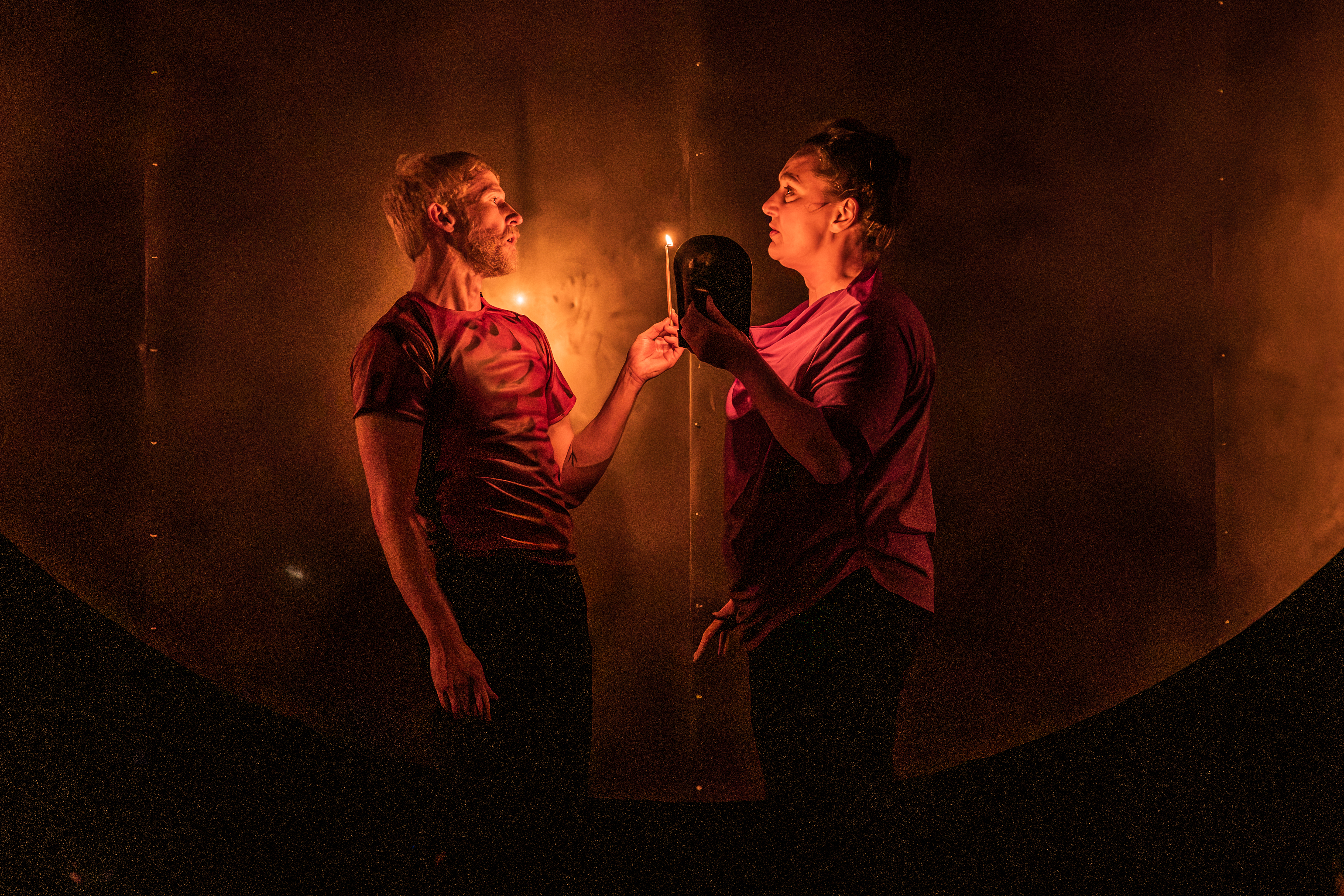
The lighting is another proud achievement. Following the venue’s tradition of candlelit performances, this feature takes on a more active role. As such, the cast carries reflector sconces to create a range of textures, emphasising the narrative’s distress, bleakness, and overall mystery.
The troupe is only half satisfactory. While Kate Duchêne shines both as Caesar and Octavius (both played with vigour and magnetism), Caoilfhionn Dunne delivers a disappointingly flat, shallow, and barely credible Brutus. On the other hand, Natey Jones excels in his nuanced portrayal of the manipulative Cassius, while Adam Gillen delivers an acceptable though slightly one-note Mark Antony.
Abridged material is usually a double-edged sword, just like the one that killed Brutus. It would be unfair to say Julius Caesar has been assassinated also as a piece; eventually, some of its human analysis permeates. But it’s no less true that much of its pathos and profundity has been given a Roman thumbs-down (if not the middle finger). It’s beautifully presented and thoroughly thought through, except for probably its most important feature.
Help us continue our work
We count on your support to keep bringing the greatest quality in theatre-related content, from interviews with the biggest names in the industry to reviews of every show in town and beyond.
We appreciate every donation to maintain our high pace and standards and continue to grow.
Thank you for believing in us!
***************************************************
Julius Caesar plays at London’s Shakespeare’s Globe until 14 February. Tickets are available on the following link.