
“There’s nothing wrong with homosexuals”, chants the homophobic crowd, terrified that bringing equality to a historically discriminated group might lead to society’s demise. There’s nothing wrong with them, indeed. With us, I should say. As for this musical, however, several factors challenge its status as the next Great British Musical (if that title has even been granted) and make the hype around it less justified.
It is an enjoyable piece of theatre. There is no question about that. The plot is solid, and it resonates across generations. If you were there, the memories will stream back. If you weren’t even born, it’s still a compelling tale of resilience and camaraderie; the kind that stands above personal differences and relies on the principles of dignity, kindness, and togetherness.

But that explains the 2014 movie’s success. And so do Imelda Staunton and Andrew Scott’s (among others) acclaimed performances. There’s something inherently heartwarming about a story of the alliance between a Welsh miners’ union and a gay-rights group. Two distinct forms of governmental victimhood. Both neglected. Both isolated, although only one of them has the additional burden of systematic abuse in every aspect of their lives.
All of that makes this narrative an exceptionally suitable concept for a musical. And in a time when film IPs have become the sole source of inspiration for new material, its transmutation from screen to theatrical extravaganza was virtually inevitable. Opening at the National Theatre last summer, the initial run sparked enthusiastic reviews and an immediate sell-out, setting a high bar that, despite the venue’s logo, I’m not sure it reaches.
It is actually an endearing piece. And for the most part, it’s quite entertaining. But it isn’t brilliant, by any means. Bookwriter and lyricist Stephen Beresford provides the writing’s strongest ingredients: his dialogue is sharp, amusing, and engaging, while his lyrics are perceptive, polished (despite some occasionally prosaic segments), and feature some interesting rhymes (“if I can be any bolder / keep Tristan, take Isolda” being a deliciously camp example).

We can’t say the same about the music. Three separate composers are credited as the show’s tunesmiths and orchestrators: Christopher Nightingale, Josh Cohen, and DJ Walde. None of them is good enough.
The melodies aren’t derivative, but they are remarkably dull and uninspired — to the point that you wouldn’t even notice any reprises. That’s how monotonous most of them are. You could swap several motifs and wouldn’t tell the difference. Every number conveys the right sentiment, but it doesn’t brim with it.
Eventually, the score lacks craftsmanship; the instrumentals are decent, but the compositional value is merely adequate. Overall, it’s like listening to a decaffeinated version of musical ideas still in the making: it’s the right approach but not the final iteration; or at least, it shouldn’t be.

Overall, the repertoire is well-structured. The characters sing when they should, and there’s the right balance among expositional sequences, action songs, and introspective solos.
There are exceptions, however: the flamboyant, gay-affirming disco number that changes the Welsh strikers’ minds should have been preceded by another rendition about their prejudice that furthers the confrontation. Others need more originality, bearing too much resemblance to previous and better-executed musicals; I’m sure Act Two’s opening brought a few memories back to Claude Michel-Schoenberg (who happened to be allocated two rows in front of me) about Miss Saigon and his Broadway expectations — in other words, his own American dream.
Many character arcs are disappointingly sketchy, too. In fact, although the story’s core is competently developed, most personages still come off thin and slightly archetypal. All in all, the script tries to comprise an incredibly eventful narrative while also introducing side plots about the protagonists’ individual journeys.
Suffice it to say, there’s barely any time (if not any time at all) to delve into them when the running time is roughly three hours. Because of this, we are left with frustratingly rushed resolutions such as a young gay man instantly reconciling with his mother 15 years after she disowned him for the crime of existing (it makes as much sense as it sounds), or a coming-out song that milks the applause almost as much as what its singer advocates milking.

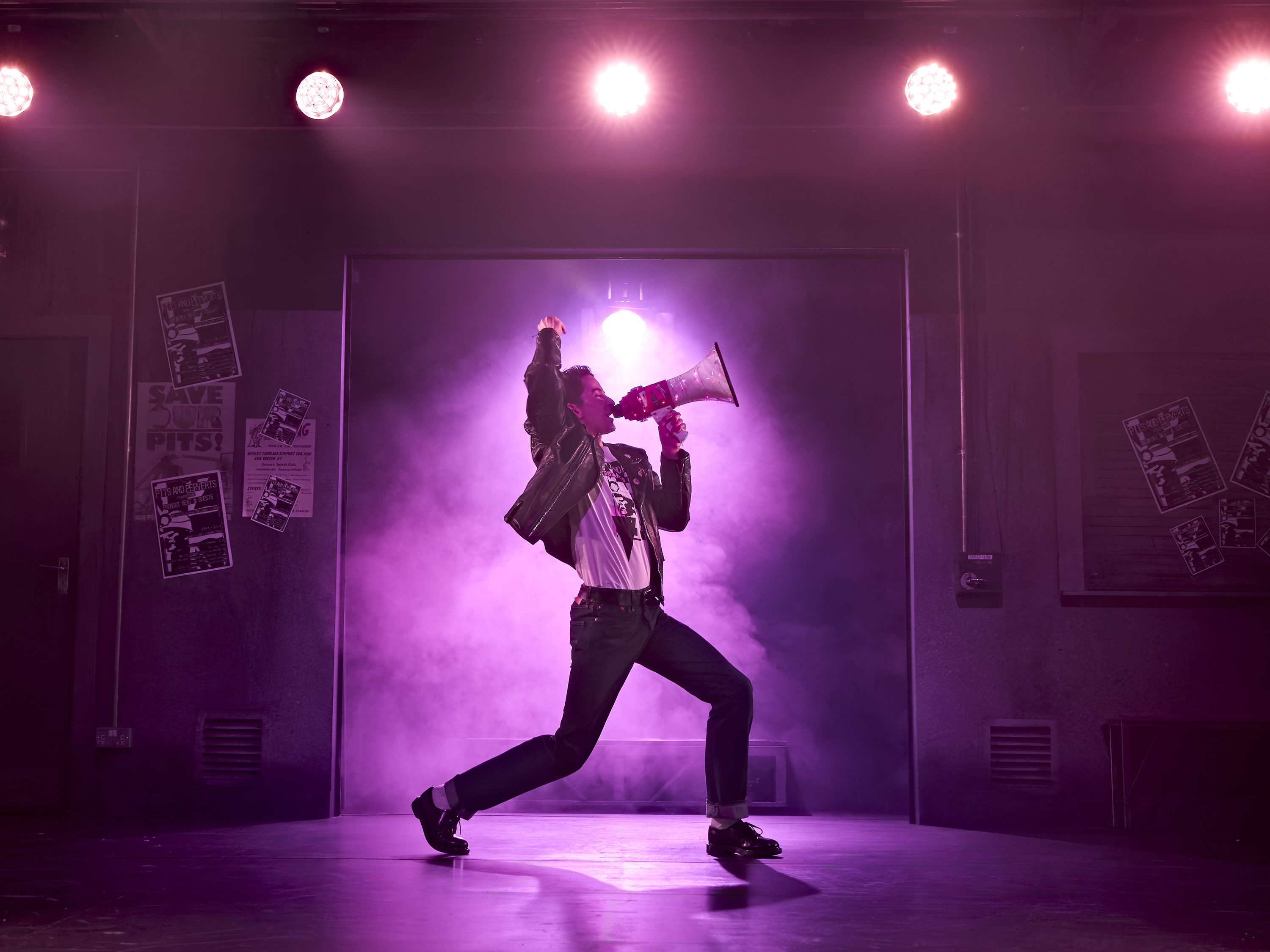
The staging is evocative and intelligent. Naked scaffolding, depictive lighting, and sporadic projections concoct a remarkably transporting atmosphere that teems with dynamism, seamlessness, and theatricality.
The cast is overall strong, but the main troupe struggles to meet all their roles’ requirements. While Ryan Kopel is lively and charming, he doesn’t capture the essence of the leader he’s supposed to be or ooze the force-of-nature energy his character is described as. Similarly, Samuel Barnett is inviting and somewhat magnetic, but his vocals, albeit satisfactory, don’t really shine.
It’s worth a watch. Even with its problems, the show is infused with poignancy. And it would take a special kind of emotional frigidity not to be shaken by it. But it can do better. And it should have as well. In the end, the work doesn’t defend its existence as a musical, as it doesn’t match (let alone surpass) the standards of its predecessor. Although I would still bring the children so they are taught they have an inalienable right to be gay.
Help us continue our work
We count on your support to keep bringing the greatest quality in theatre-related content, from interviews with the biggest names in the industry to reviews of every show in town and beyond.
We appreciate every donation to maintain our high pace and standards and continue to grow.
Thank you for believing in us!
***************************************************
All pictures credit to Manuel Harlan.
Pride, The Musical plays at London’s Bridge Theatre until 8 May. Tickets are available on the following link.