
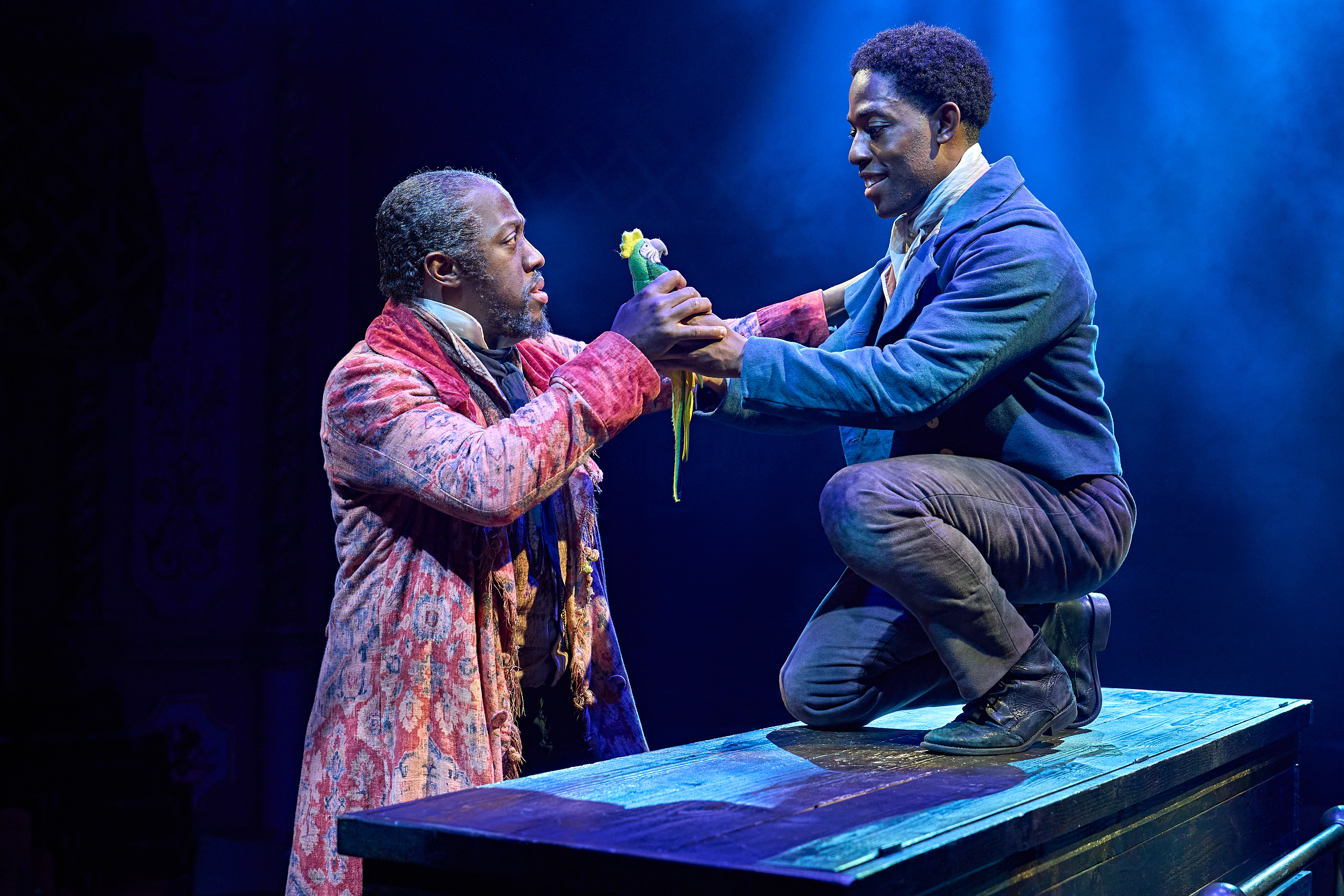
Marley was dead, to begin with. Fortunately, this show is not. Even ten years after its world premiere, the production is still full of life. Whether it’s full of substance is another story. And it doesn’t seem to be building to a happy ending. But let’s not get ahead of ourselves. Despite its dramatic flaws, Matthew Warchus’s stage adaptation of the holiday classic offers enough spectacle to be considered a treat —though only to the eyes, and maybe the stomachs of those who managed to grab a complimentary mince pie before the performance.
There is a reason why Charles Dickens’s seasonal pièce de résistance has stood the test of time: it features a compelling character arc for its protagonist; it’s infused with the Gothic allure of Victorian storytelling; the plot brims with wonder and poignancy; and above all, it delivers a powerful message of kindness, empathy, and benevolence.
Dickens’s precarious upbringing (he was forced into child labour at the age of twelve following his father’s incarceration) pervaded the pages of this instant literary hit (often credited with reinvigorating public interest in Christmas across the English-speaking world). But its true intentions stood somewhere else. As the withering Ghost of Christmas Present edifies Scrooge (and by extension, the reader) through the monstrous revelations under his robes, Want and Ignorance are the two maladies that we, as a society, are conscience-bound to heal.

Dickens’s novella is, first and foremost, an urgent call to action. It is the spirit of the piece, and in the wider sense, the essence of the Christmas Spirit. Yet, Jack Thorne’s script tiptoes around arguably the book’s most important theme, relegating it to a short spiel and fundraising during the curtain call.
In contrast, this version belabours the personal consequences of Scrooge’s interactions. It’s no longer about how his greed and disdain for compassion and altruism jeopardise the greater good. Poverty is still mentioned, but it’s barely explored. As a result, the recount’s emotional impact fades. And so does its influence.
Thorne’s approach downsizes the narrative’s philosophical and dramatic scope by oversimplifying the protagonist’s journey. In some way, the writing becomes as stingy as the archetype it’s supposed to criticise. The repercussions of his actions are limited to his private gain: being mean to people equals solitude; being kind is met with reciprocity.
The script references some of the book’s socially aware segments: a group of carol singers visits Scrooge to collect money for the poor, whom he dismisses; and his relationship with Tiny Tim is brusquely introduced. But the original work’s hortatory ethos vanishes, and a far less commentative story takes over, eventually veering into the melodramatic.

As such, Scrooge reconnects with his younger self. Later, he’s reminded of letting go of the love of his life when working for his first employer, Fezziwig (now an undertaker and Belle’s father). While these sections are the novella’s heart, this adaptation struggles to deliver the same degree of pathos.
It doesn’t stir on the same level. It feels rushed, lacks expanded context, and clumsily tackles the themes of loss, regret, and absolution. At the same time, some aspects of its cautionary tale are questionable (call me strange, but giving the brush to his abusive father when he asked him for money seemed like the right thing to do).
In the end, Scrooge does undergo personal growth, but it’s depicted rather vapidly. His interpersonal relationships come off as one-dimensional and formulaic. Some of his realisations carry insight, but it’s very sketchy. And for the most part, the execution is so superficial that the introspection is practically nonexistent.

The production value is the main highlight. And admittedly, the only true reason to come. Performed in the round (since last year, surrounded by an amphitheatre instead of the usual elevated cross-like stage), Rob Howell’s sets convey grandeur through a simple yet remarkably atmospheric and theatrical design. They are, by all means, magical. And they feel as such, much like Christopher Nightingale’s (a surprisingly appropriate surname for a composer) transfixing Celtic underscore.
Giles Terera delivers an underwhelming Scrooge. Overall, his portrayal is flat, lifeless, and stilted. He doesn’t play a character; he merely recites. As a performer, he has presence, but he doesn’t bring depth to the role, let alone soul. We can’t relate to the protagonist’s anger, grief, or any sentiment, for that matter. They are just not there. His interpretation improves slightly during the second half, but ultimately feels ungenerous to the viewers. Unequivocally, previous actors have done much better.
Those familiar with the production know what they’re coming for, and they will probably enjoy it. It comes back every Christmas, a tradition that will probably continue — clearly, something resonates with a section of the audience. It is an entertaining watch. And the ensemble defends it well. But don’t expect a touching exploration of human redemption, because you will not find it. It’s been replaced by another idol — a golden one.
Help us continue our work
We count on your support to keep bringing the greatest quality in theatre-related content, from interviews with the biggest names in the industry to reviews of every show in town and beyond.
We appreciate every donation to maintain our high pace and standards and continue to grow.
Thank you for believing in us!
***************************************************
All pictures credit to Manuel Harlan.
A Christmas Carol plays at London’s Old Vic until 9 January. Tickets are available on the following link.