
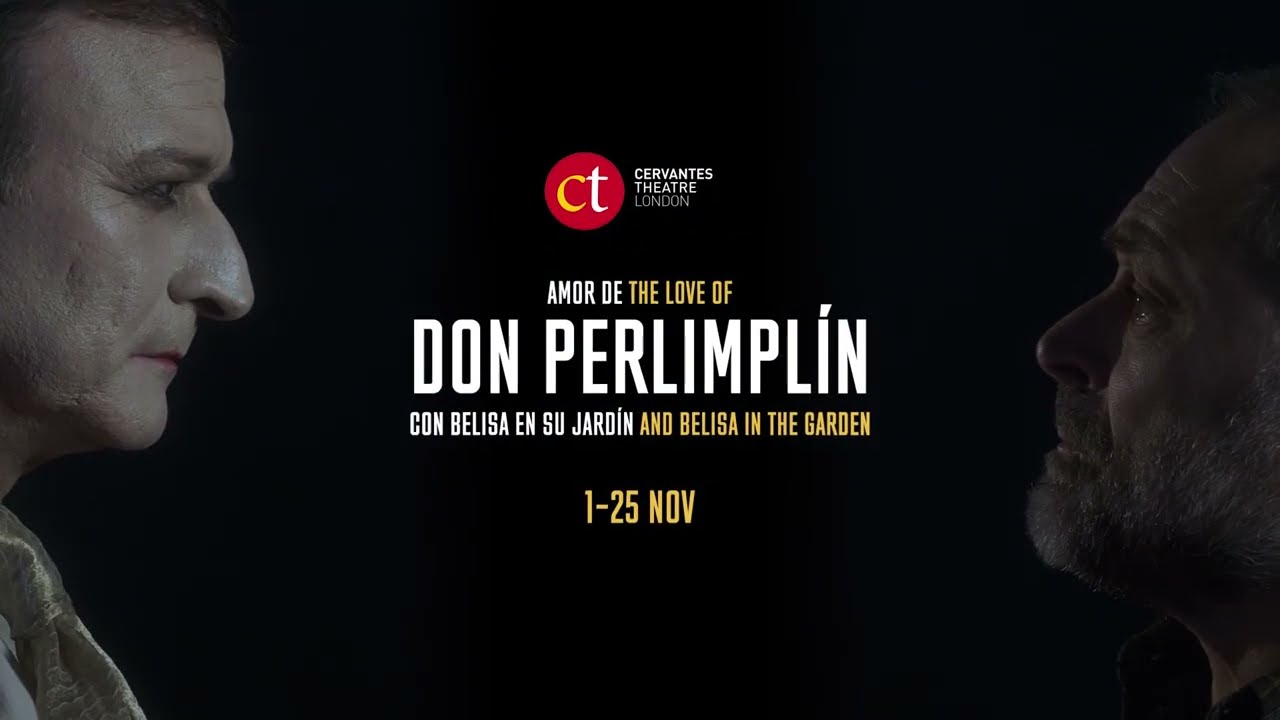
Lorca’s classic short play relives on the London stage through this new adaptation combining tradition and modernity. Guillermo Nazara shares his views on the show, to explore all the facts about a work perhaps depicting the author’s most personal side.
The only thing worse than a broken heart is a heart that’s forbidden to feel. We only need to gaze upon Lorca’s life to wonder if the dramatic force driving his plays was actually his own personal one. A crave for love that somehow seemed to always go unfulfilled, his astute portrayals of the human soul (often, shattered in one way or another) are still piercingly relatable due the universal character of its themes. We all want romance, and we wish for it to be true. But when that doesn’t happen, we might as well invent it.
Though penned at the turn of the century, the tale of Don Perlimplin has many of the elements featured in the recurring affair plots popularized during the Spanish Golden Age: a young, beautiful wench waiting to be wedded, a bashful suitor thirty years her senior that wants her for his wife, and an amorous twist depicting the country’s signature mischief. With its ending, perhaps, serving as a allegory for Lorca’s inability to live his own reality to the fullest, this short play presents us with several trascendent topics exploring both the purity and corruption of our spirit: the longing for the unrealised needs of our sentiments, but also the crooked actions we may be willing to take to make those happen. Or perhaps, after feeling manipulated about them.
The Cervantes Theatre has revived the old boy (figure of speech) through a new production experimenting with both a traditional and modern approach. Directed by Paula Paz, the show opens with the original version of the recount (language, included) – depicted through period staging despite its Brechtian set design. Forty-five minutes later, it’s all coming back to us now – as a surprise in the stalls (no spoilers) will announce that the performance is far from over, with the same tale now unraveling again in a nowadays atmosphere and in English.
An interesting concept to carry out, the suggested duality of blending the lead’s love interest with both a male and female actor (possibly, suggesting Lorca’s homosexuality as the reason why he wrote the piece), while also hinting the idea that our essence as people never changes no matter the age we’re in, are undoubtedly the highest points of the montage. In addition, its intricately executed lighting, providing the performance with evocative visuals and rich textures, endows the production with another strong, memorable point.
However, repeating the full script doesn’t seem to really work, most sadly – halting both pacing and interest, as there’s not that much of a surprise to be expected when we already know what’s going to happen. Though exciting from an acting perspective, with some renditions being delightfully delivered, the result, as an account, is closer to a workshop than actual storytelling – showing us the possibilities that one single narration can have, but not building much of a cohesive arc and resolution, in spite of its attempts to blend them together.
There’s still moments of enjoyment, nonetheless – thanks to the several laudable performances, making of it a grasping watch at more than a few moments. In the Spanish side, Maite Jiménez shines as Matcolfa through her infectious magnetism, constructed through her refreshing naturalness combined with most energetic presence. As for the English (and also the entire montage), the highest praise is earned by Paul Rider, for endowing his part with new details of personality, bringing out the fragility and a more sympathetic, realistic take on his role.
Parting from an exciting premise, this reimagined impression on Lorca’s work gives a new pulse to the source material, but still needs to polish its outcome to keep its rhythm on a steadier beat. Both parts should mix together and complement each other instead of mirroring themselves. Make them join forces to create one single reality – that way, perhaps, it may end up more truthful than the original.
The Love of Don Perlimplin plays at London’s Cervantes Theatre until 25 November. Tickets are available on the following link.