
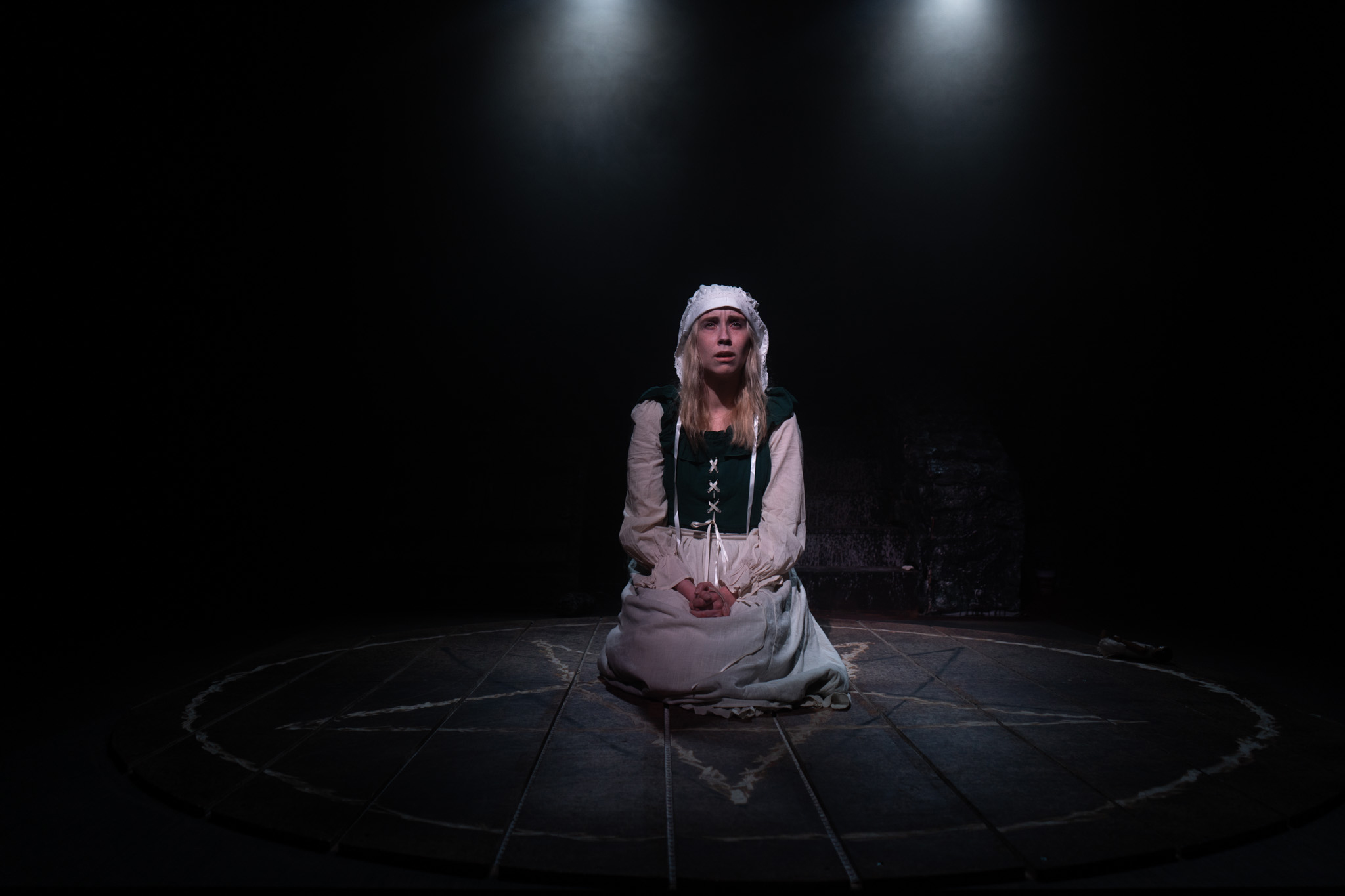
The Bridewell Theatre hosts the London premiere of this new horror play, dealing with the curse of a tormented spirit taken revenge for all eternity. Guillermo Nazara shares his views on the show, to let us know if this bleak recount exploring the powers of the hearafter ends up digging its own grave.
Truth is the basis of every lie. Even when someone tells you that you’re pretty, there’s an element of verity hidden beneath those words (which probably resides in the delivery). Come on! You know I’m just joking… Maybe there’s an exception to what I just said at the beginning… Whatever the case, when it comes to the biggest lie all (and I mean theatre, not overpromising “close friends” stories on Instagram), there is a rule that can never be missed – let alone, broken: for any plot to work, you need to make your audience believe it’s real.
Witch-related stories are, in all likelihood, the most common type of folklore circulating around the UK – and presumably, the whole Western world. I, myself, could bring up a few anecdotes too, but I think that the term is pronounced in a more German way for those sorts… Coming to see a new horror tale dealing with the paranormal, while also providing some historical perspective, seems like the perfect opportunity to reunite with the genre – anticipating an evening of sudden thrills and jumpscares, supported by the solidity of an introspective, character-evolved narrative. The real shock, however, comes when, most sadly, none of those expectations are met.

Taking us through the tragic plight of a 17-hundreds English woman, spitefully accused of sorcery for no other reason than a gruesome vendetta, the recount revolves around a young University student, Erin (Jessica Porter), who, accompanied by her brother Sam (Saul Bache), ventures into the place where those terrible events occurred, in order to learn the facts concealed behind the lore. Little does she expect for that myth to be just the tip of a much more macabre legacy – the kind no one would even wish to know about; not to mention, trifle with.
A gripping premise with unending possibilities, the influences helping construct the account’s ground and finish are evident, and to some extent, welcome. From elements taken from more entertainment-based works like The Ring or even The Omen to more sophisticated pieces of art such as The Exorcist and, unmistakably, The Crucible, the inspirations concocting the play’s general flavour are easy to grasp and, to some level, enjoyable to spot. Yet, it’s the absence of an independent voice, added to the lack of a stronger dramatic force, that prevents the work from finally taking off and, eventually, delineating a journey of its own.
Often struggling to bring a steady rhythm to its pacing, too many excerpts feel either rushed or overdone – regrettably, putting too much emphasis on details that contribute little to none in the progress of the story, while overlooking aspects that, instead, should have been presented as the core of its arc. On the other hand, the dialogue, though occasionally charming thanks to its humour and also displaying some discreet hints of profundity, is generally in need of a better flow – feeling too static and, all in all, unnatural, and pushing too hard for an emotional effect that, unfortunately, never manages to materialize.

The main problem affecting its cogency may stem from the use of too many components – which, instead of working altogether, only appear to compromise one another. Subplots and confronting angles are always required for a narrative to be compelling, but there needs to be a motive behind their existence other than piling up sensational mechanisms. As a result, the piece slightly seems lost in regards to its identity – drawing out a few interesting topics, but incapable of offering enough insight and character to them to craft a stand-alone vision.
Some credit must be given, anyhow, to some of the production’s values – especially to its soundtrack. Written by Ashley M. Walsh, his melodiously fierceful themes, nurtured by the styles of film and television composers like Mark Snow and Jack Nitzsche, is undoubtedly the grand winner in the entire montage – executed with absolute dexterity from a recounting point of view, while also contriving a few memorable motifs that exude enough autonomy by themselves.
A committed effort showing extremely laudable intentions, The Witching Hour makes time for a promising setting that, given the right treatment, could have more than the ghost of a chance to succeed. Yet, the spell is, most sorrowfully, broken almost from the start through an account that, despite its many endeavours, still needs to master its skills not only at bringing out the terror – but most importantly, its own spirit. It deals with subjects concerning the afterlife, but there’s still a long way ahead before it carries a soul within.
The Witching Hour plays at London’s Bridewell Theatre until 20 July. Tickets are available on the following link.