
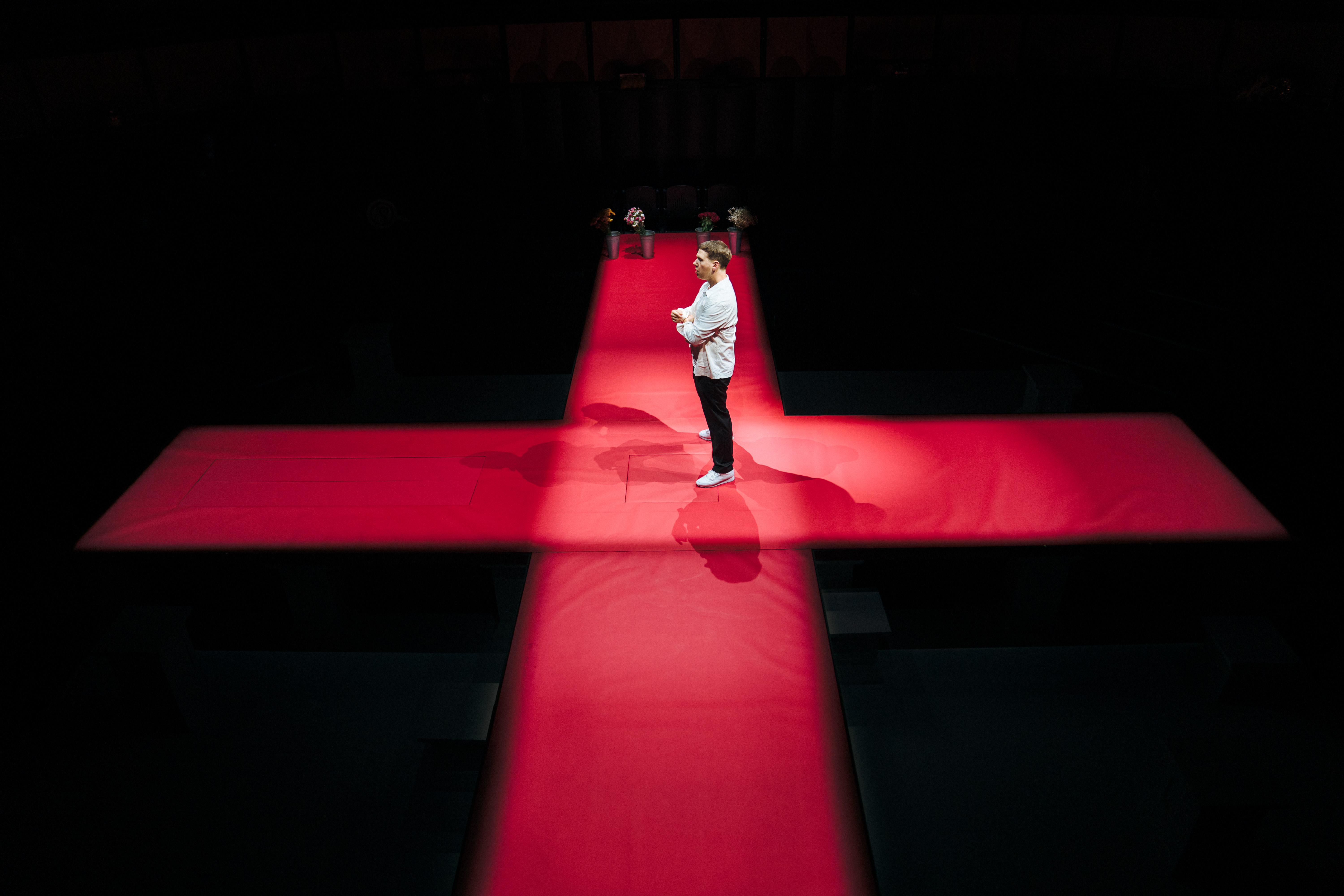
The National Theatre brings back Dyer and Williams’s hot-blooded trilogy, depicting the country’s tumultuous zeitgeist through the singular eyes of everyday people. Guillermo Nazara shares his views on the show’s first two installments, to let us know if this harrowing portrait of modern society manage to knock audiences beyond its name.
British houses for British people. That’s all it took for this vainglorious lodger advertising his spare room on social media to justify his disdain towards any underserving English-unborn applicants. He voted Reform in the last elections (that, he stated with questionable pride), and denying any chances to everyone unfit for his idealization of the “pure-blood mold” didn’t make him, to the best of his knowledge (and I can’t stress that phrase enough), a racist. Well, in his defense, that’s more of a xenophobe – but I doubt the poor chav’s dexterity with words is any way better than his philosophical thinking.
It’s almost ironic to think that I bumped into that ad only a couple of days before coming to the opening night for the West End transfer of the National Theatre’s Death of England: The Plays. Despite the hype during its original run, I must confess I literally knew nothing about the premise of the show – let alone, that it would consist of three separate parts with intertwined storylines. I must also admit that, had I known prior to attending, I may have reconsidered the invitation. A play dealing with societal prejudice, cultural injustice and the biggest provider of “I-told-you-so” moments (aka Brexit), the prospects of finding yourself trapped in an evening (and afternoon too, in this case) of boundless onstage preachment are frightfully strong. Then again, we always find some creed in our lives that we fancy following…

Penned by Roy Williams and Client Dyer (the latter, also serving as the montage’s director), the pieces presents Michael and Delroy – each one, performing their own individual monologues for over 90 minutes straight-through. One, white and raised in an all-English family with “good” old traditional values. The other one, black and innate to this country, but coming from an immigrant background. Not surprisingly (except for the ones who lay their expectations in the personal boxes they create), life is tremendously harsh for both of them. But shockingly enough, for the same reasons – even though those affect each of them quite differently.
Exploring a wide range of themes going from such contrasting such as race-divisive attitudes to parental relationships, the greatest success of its writing lies on the generally accomplished smoothness and cohesiveness as for the introduction, interrelation and use of every subject as an indispensable driving tool for the efficiency of its narrative. It covers matters that some people may find controversial (just don’t peep over their ballots), yet apart from some very minor bits, it never feels as the viewer is being mentored – but instead, given the chance to make up his mind (with some help and direction, that is) in a most organic manner, weaved through the honest reflections of a genuine, tangible character.

With both scripts borrowing elements from each other to concoct their recounts, the texts develop a rather gripping ride (Delroy’s being slightly more absorbing, though), which, despite a few small shortages in the personages’ arcs (particularly, Michael’s), is able to seduce and, ultimately, captivate us with an emotionally-pungent and thought-provoking excursion. Led by two completely opposite individuals, the universal foundation of its material secures as astonishingly pleasant proximity with the spectator – making us feel connected and, in some strange way, understood by pointing issues which, though they may not be exactly what or how we’ve experienced, are anyway able to offer a bond with our own journey.
A great deal of its triumph stems from both actors’ exceptional performances. Starring Thomas Coombes as Michael and Paapa Essiedu in the role of Delroy, both artists deliver their parts with astounding poise and flair. Fully transformed into their personas, the sincerity of their rendition is truly remarkable – and ever so powerful, it can almost be breathed. Perfectly timed and flawlessly executed, both are still able to ooze some hints of spontaneity, rendering their portrayals with extraordinary ease without ever seeming too over-rehearsed. In addition, Jackie Shemesh’s suggestive lighting, combined with Benjamin Grant and Pete Malkin’s surrounding and occasionally psychological sound design, are the final element to solidify its much tenacious and encompassing atmosphere – fully immersing us not only into the play’s setting, but also into its emotional cargo.

A deep, protracted hike up the steep hills of a conflicted existence, Death of England brings up a vivid, heart-felt and blaring illustration of the venomous antidotes we, as humans, are tempted (and too many times, won over by) to use in our quest for survival. Outlining an engaging narrative filled with action, while also allowing enough room for their characters’ contemplation, the show composes a compelling tale while making a reasonable statement: most of us aren’t either victims or villains, but, as the Bard once put it, just actors in that unguided stage that’s the world.
All pictures credit to Helen Murray.
Death of England plays at London’s Soho place until 28 September. Tickets are available on the following link.