
Following a critically acclaimed run at the Edinburgh Fringe last year, Paines Plough’s solo act arrives in the West End in a new production starring four alternative A-list performers. Guillermo Nazara shares his views on the show — to let us know if its uplifting message remains immortalised through the rendition.
We don’t talk about suicide. In all fairness, it’s not a pretty subject of discussion. I can’t think of any possible scenario where it wouldn’t be triggered either by misery-scavenging gossip or overwhelming suffering. Life is not an easy journey; we’re all aware of that — perhaps, too early on. And that’s why we should look for ways to flatten its path, even if we still must cope with the hurdles it will bring along.
Spiritual resilience and positivity become the two driving forces in Duncan MacMillan’s play, which celebrated its West End opening on the Soho Place’s stage this week, following the hype of last year’s lauded run at the Edinburgh Fringe. Playing until mid-November and featuring a roster of four A-list actors taking over the role in this solo (ish) performance (we’ll talk about that later), the script invites audiences on a journey of literal and metaphorical growth, through the eyes of a child, adolescent, youngster, and adult, and his way of coping with the trauma caused by a dysfunctional household.

It doesn’t feel like the most promising premise in terms of humour. And yet, you will likely keep roaring for most of the performance. The script makes a difference by moving away from the drama without sacrificing the poignancy of its story. It doesn’t deny the grief a son dealing with a suicidal mother unavoidably goes through. But it shows us how even the darkest times can still offer some light if we set ourselves to find it — or make it ourselves.
It’s an excellent concept that resonates from both an artistic and philosophical perspective. And to a considerable extent, the script carries it out with notable skillfulness. There are hardly any moments when the rhythm slows down, keeping its cadence at a fast, steady beat that refuses any superfluous elements for the sake of directness. It works on some level, but in its effort to trim the fat of a potentially overcontemplative text, a bit of muscle has been given up, too.
It would be unfair to say the narrative doesn’t flaunt a solid structure. The plot’s overall sequencing is robust, and all the core events it requires are in place. The problem stems from its occasional lack of buildup, which prevents the recount from unfolding to its full length. Consequently, it constrains part of its emotional intensity and significance — leaving us with an ending that can still come off as stirring, but which is never exempt from an uncomfortable aftertaste of rush and slight underdevelopment.

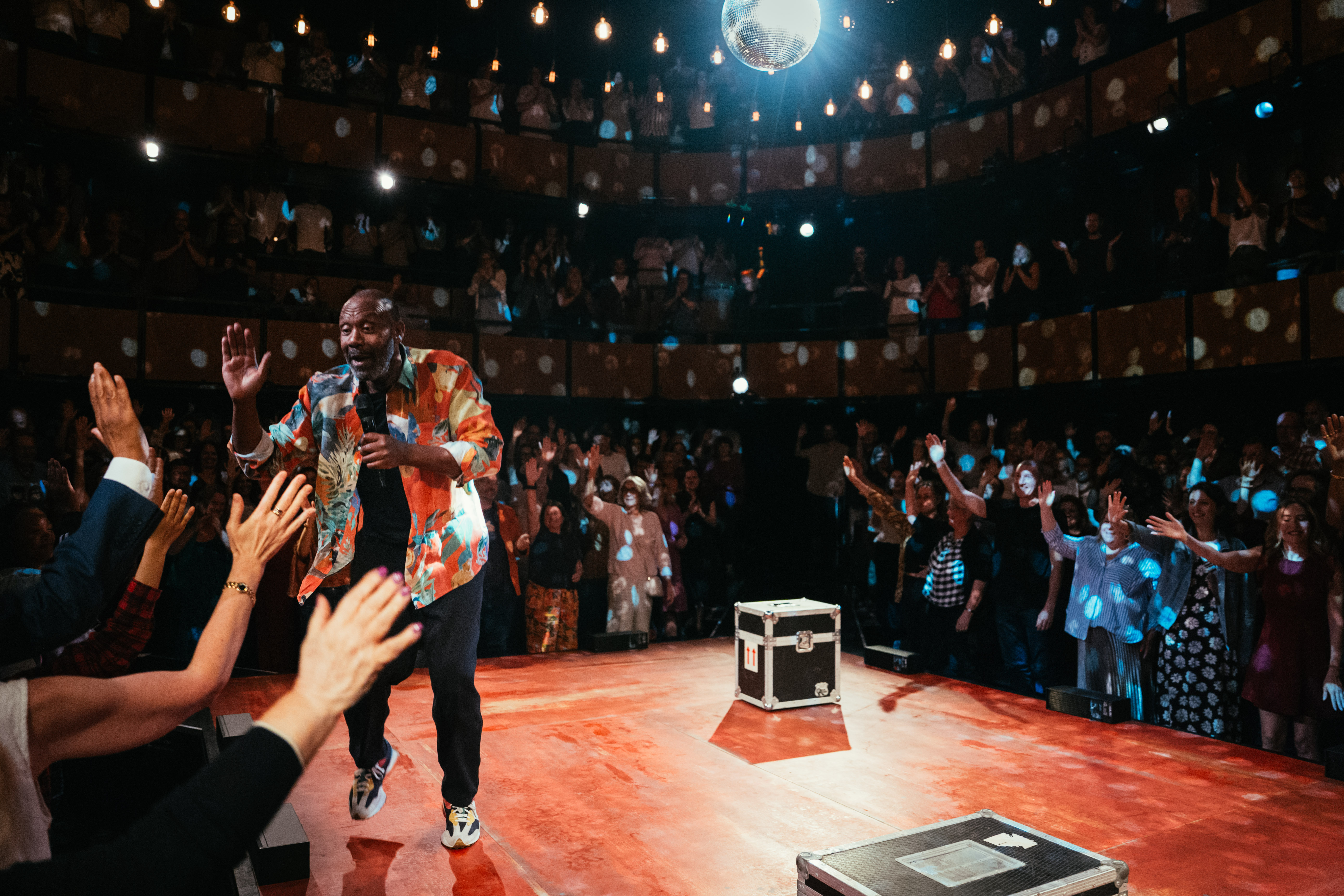
Under MacMillan’s direction, along with Jeremy Herrin’s, the performance is devised as an interactive experience — arguably one of the piece’s key strengths and a reason for its moderate uniqueness. An infinite list of beautiful things in the world (also known as “every brilliant thing”) is recited throughout the rendition, as random viewers are given cards and aleatorally called to shout out which item is mentioned in theirs. Some other guests will be taken on a more intense theatrical workout, suddenly becoming characters in the show, with their improvisational skills fervently put to the test. It’s an effective tool that successfully preserves the narrative’s overall engagement, though its continuous use inescapably leads to a slightly gimmicky impression.
Lenny Henry gives an enjoyable solo rendition that excels in presence and naturalness. However, his interpretation rarely comes across as the portrayal of another individual. There is deftness in his execution, but no layering or profundity, speaking on the protagonist’s behalf without letting the personage communicate through him. As a result, we can only see the role’s outside, with his spirit nowhere to be found; and the pathos can’t fully materialise due to the faintly rough state of his act, deprived of personal connection and, eventually, a more palpable sense of truthfulness.
Exploring a harrowing subject through a shining beacon of hope but not offering the same richness in its delivery as it does through its text, Every Brilliant Thing brings together a compelling roster of themes and ideas — which, had they been kneaded and cooked for a little longer, would have concocted a 5-star dish of theatrical delicacy that ticks every box in anyone’s book. There’s still room for a second course to give a try, and a better handling of the material may even disguise its tiny flaws. With that in mind, I think I’ve got myself more than a mini driver to review it again in October.
Help us continue our work
We count on your support to keep bringing the greatest quality in theatre-related content, from interviews with the biggest names in the industry to reviews of every show in town and beyond.
We appreciate every donation to maintain our high pace and standards and continue to grow.
Thank you for believing in us!
***************************************************
All pictures credit to Helen Murray.
Every Brilliant Thing plays at London’s Soho Place until 8 November. Tickets are available on the following link.