
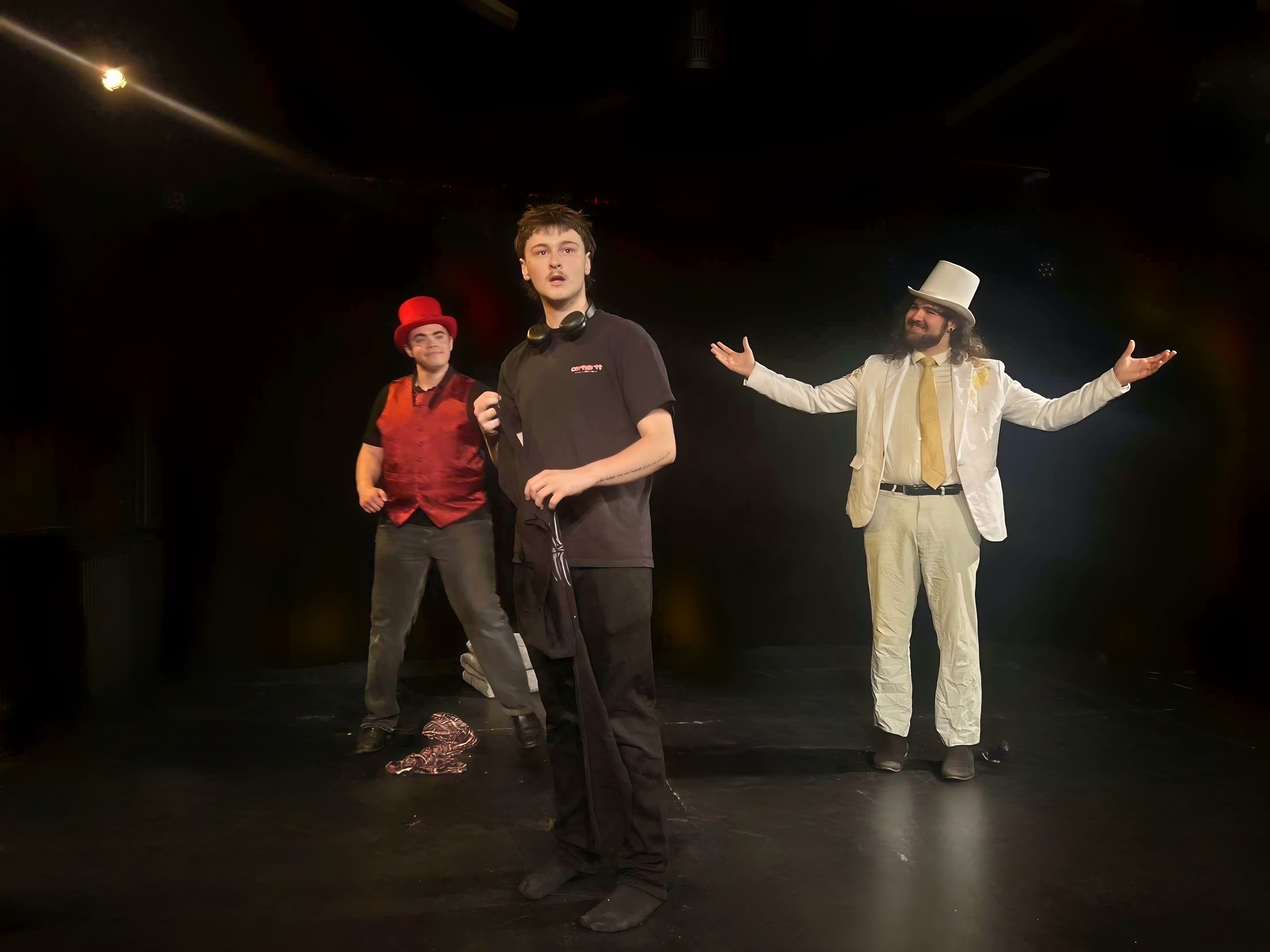
Following a first incursion at the Edinburgh Fringe, the show lands on the London stage for a limited run until the end of the week. Guillermo Nazara shares his views on the show to let us know if this religious-based exploration of mental health led to a divine experience or if, instead, it stinks to high heaven.
There’s nothing heavenly about this show. Neither is there anything grounded or worth unearthing. It might aim for a divine tone, but that would be of an angel that’s fallen lower than Lucifer, a prominent character in this humdrum, underdeveloped rehash of whatever story they’re trying to tell, and who, for the record, goes by the name of Gary in his everyday — or so one of its many, many, many clunky lines states.
The poor chap is not to blame. At least, not the real-life incarnation. In fact, he might get busy after learning what went on last night at God, The Devil and Me, which landed on The Lion & Unicorn Theatre’s stage upon its Edinburgh Fringe run. It may be harsh to say that sins were committed. Then again, reviewing is all about pointing out those precise actions. Yet, if I’m not allowed to use that expression, I guess I can warn the Prince of Darkness about impending competition — some way or another, there was eternal damnation yesterday, and there will be down below.

A young teenager thinks himself capable of talking to both God and his arch-nemesis. Why shouldn’t we believe him? Anywhere he goes, he’s escorted by a bland depiction of how good and evil are personified in Western tradition — trident, spiky tail, and halo excluded. It turns out that he’s the chosen one. “Why me?” he asks. “Why not?” an assertive but vaguely convincing almighty deity replies.
It only takes a few pages to realise that the script has set up a blurred, unsafe path for itself. The cliff is proximate and unavoidable. And sooner than later, the whole thing plummets and crashes — hardly can their pieces be reassembled in a satisfactory manner.
Suddenly, the plot takes a much predictable, long-awaited, but barely welcome twist — those voices in the protagonist’s head are, in fact, just voices in the protagonist’s head. He’s committed to a mental institution to receive the help he needs. Ten minutes later, he’s almost as good as new, and it’s implied that his stay won’t be extended. Lights out. End of the play. And the start, if not the final materialization, of a deep state of confusion about what the show actually wants to tell.
We can appreciate the ethos of its premise — a portrayal of how intrusive thoughts become somebody’s personal weapon to battle a reality filled with trauma and neglect. Gabe, the lead, feels rejected by his mother, and her religious obsession has triggered this psychotic fantasy. To some extent, it worked as a coping mechanism in the beginning, but it’s rapidly evolved into delusions of grandeur, anxiety, and eventually, self-destruction.

You may argue that these are all highly compelling themes, and you would be right to do so. The problem is that their exploration is as extensive as the mention I just gave. Ultimately, it’s an exceedingly vapid play, which tiptoes across every topic without ever looking back.
Consequently, there is no stir or grip at any moment. The characters are sketchy; the dialogue is artificial, shallow, and dull -although it clearly sees itself otherwise-; and the structure is incomplete if not absolutely missing. No element in the narrative is fleshed out for us to connect with — let alone care about. Suffice to say, it’s the opposite that’s often achieved. And on some occasions, perpetuated.
The cast does their best to deliver a vacuous text with no dramatic impact. There is rapport and some degree of naturalness, but not proper chemistry. Their lack of experience is palpable, too. Inevitably, the result is an adequate but unmemorable performance, some of them being worthier earners of that commendation than others.
Writer Fionnuala Donnelly has made a bold and admirable move by reflecting her struggles with mental health in God, The Devil and Me. Nonetheless, despite the truthfulness of the source material, the sense of authenticity has yet to make an entrance in this piece. Rushed, unprocessed, and rarely engaging, the play is a courageous step to exorcise her own demons. However, the road to theatrical paradise is still to be walked, and it will be longer and significantly more arduous. We don’t need authors to raise hell to put us through a flaming journey. All that we ask, though, is not to be left fuming.
This site is proudly sponsored by

Help us continue our work
We count on your support to keep bringing the greatest quality in theatre-related content, from interviews with the biggest names in the industry to reviews of every show in town and beyond.
We appreciate every donation to maintain our high pace and standards and continue to grow.
Thank you for believing in us!
***************************************************
God, The Devil and Me plays at London’s The Lion & Unicorn Theatre until 10 January. Tickets are available on the following link.