
The show makes a comeback to the London scene on the very stage where it originated. Guillermo Nazara shares his views to let us know if its sanguine return should be given the axe.
There’s a love song. A love song about a business card: it’s bloody ridiculous. And that’s what makes it bloody brilliant. And also, there’s a lot of blood. He’s back. Patrick Bateman is back. If you don’t remember him from Mary Harron’s 2000 insipid film adaptation, you probably recognise him from the countless clips, memes, and impersonations that populate the social media sphere.
The character is said to have redefined the Western understanding of masculinity. His legendary morning routine has been both the subject of parody and admiration. Not surprisingly, the latter may have become more prominent recently.
There’s no question that Bret Ellis’s infamous character still resonates in our world. Actually, it may do so now more than ever before. Conceived as a parody of the yuppie generation, his material-based sense of worth couldn’t align more with today’s standards, which our screen-dominated communities pressure us to embrace.

It’s no coincidence that its musical revival has inaugurated the Almeida’s 2026 season, and its unexpected appeal may be linked to its uncanny proximity to our current reality. It’s supposed to be satire. And it shall be understood as such. Still, it comes as a perfect example of something that’s funny because it’s brutal — and every meaning of that word perfectly describes what American Psycho stands for.
There’s a stronger, more honed arc in this version than there was in the movie. The role has more humanity than his Hollywood counterpart, played by an unforgettable Christian Bale, whose shower scene may have contributed to his immortality.
His soulless, hedonistic morals are the direct result of unfulfilled emptiness. He’s not a classic villain, but a savage antihero driven into heinous acts as a result of the self-centred, money-oriented universe he’s somewhat trapped in. He’s still trying to fit in, but at the same time, he can’t endure the superfluous existence he’s consumed by. Consequently, he feels the urge to sever those ties — and he does in the most vicious manner.

Both book and score work in absolute unison to explore the protagonist’s decadence and his descent into insanity. The lines are soaked with wit and irony, but they still allow us to empathise with the character and his desperate longing for purpose.
Act One works impeccably well. The blend of song and dialogue is seamless and faultless. Every number is justified, advances the plot, and provides compelling insight about the personages’ journey. There’s just the right amount of exposition, with the story moving along at a steady and gripping pace. And every spoken interaction has subtext and flow while adding to the delicious commentary the piece delivers as a whole.
It’s a remarkable effort — an artistic tour de force supported by its indisputable post-modern raison d’être. The characters’ detached nature is precisely what builds an attachment with the viewer. They are completely out of touch, and watching them mingle in their golden bubble, much like zoo creatures, is as amusing as it is discerning.

Act Two doesn’t flaunt the same calibre, however. It’s still competent — for the most part, there’s depth and entertainment. Yet, we’re not as violently shaken by its execution as its preceeding part. The rhythm suffers from occasional stagnation — it’s not as faultlessly thrilling and engaging as it was before. And the alternation between spoken and sung-through segments doesn’t feel as cohesive.
In any case, we can still acknowledge a mostly triumphant finale, which overall achieves climatic plangency. The lyrics wrap the recount through an excellent observation of the piece’s significance, exhibiting the same refreshing qualities they’ve brimmed with during the entire performance — bold, sharp, and molded through generally splendid rhymes that ooze intelligence even when they’re imperfect.
The music is equally good. A distinctive 80s-90s techno-rock flavour permeates the score and solidified through captivating melodies, many of which are undeniable earworms.
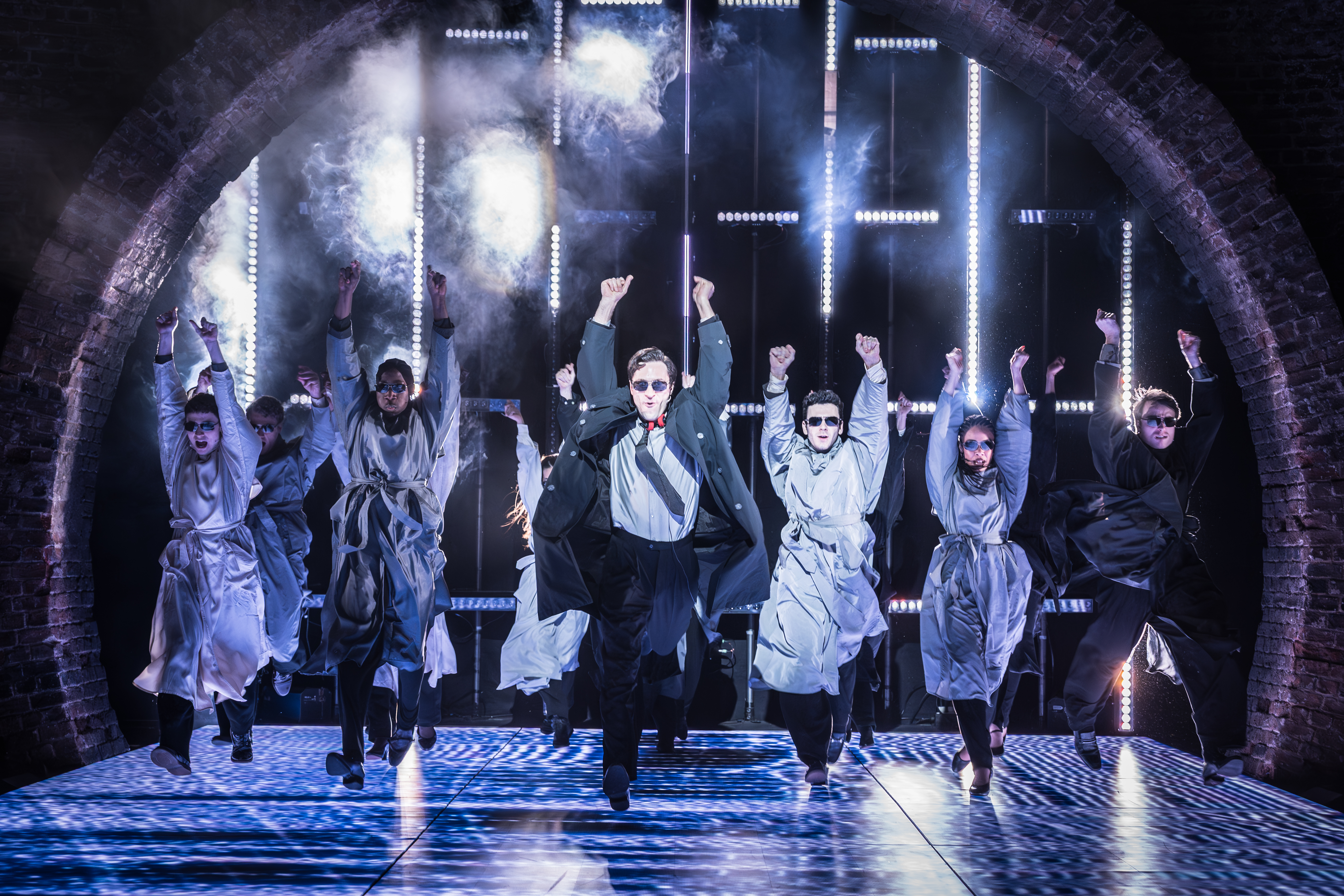
The staging is visually attractive, highly dynamic, and vastly metaphorical. The sterile rationale that forms Bateman’s world’s conformist lifestyle pervades each scene. So does his brazen inner conflict, which is often depicted through abstract video projections inspired by screen white noise and sound waves. Cold, fluorescent lighting and the minimalist approach of its set design provide the rest, evoking every location with superb intricacy and several strokes of inventiveness.

The company does every possible justice to the material. Most of them demonstrate great versatility in their acting, satisfying vocals, and extraordinary dancing skills, which are continuously showcased through an eye-popping, highly energetic choreography.
Arty Froushan’s Bateman adds a new layer to the character. His interpretation captures the ethos of the adaptation with ample deftness. There’s the antisocial narcissist, but there’s also the frail victim of a corrupted system. There’s a faux façade of charm, yet his shattered authentic self craves to come out. And there’s an element of campness to him, which eventually accentuates the role’s gravitas.
The film had major problems. Still, it’s gathered a cult following across its almost three decades. The musical’s significant improvements may earn it a larger fanbase. It’s not faultless, but it still ranks near the top. And admittedly, it’s taken a killer to inject new life into a decaying musical theatre landscape. I would confidently recommend audiences not to give this one a miss. I must go now — I have to return some videotapes, and a reservation at Dorsia. Hasta la vista, baby.
This site is proudly sponsored by

Help us continue our work
We count on your support to keep bringing the greatest quality in theatre-related content, from interviews with the biggest names in the industry to reviews of every show in town and beyond.
We appreciate every donation to maintain our high pace and standards and continue to grow.
Thank you for believing in us!
***************************************************
All pictures credit to Marc Brenner.
American Psycho plays at London’s Almeida Theatre until 14 March. Tickets are available on the following link.