
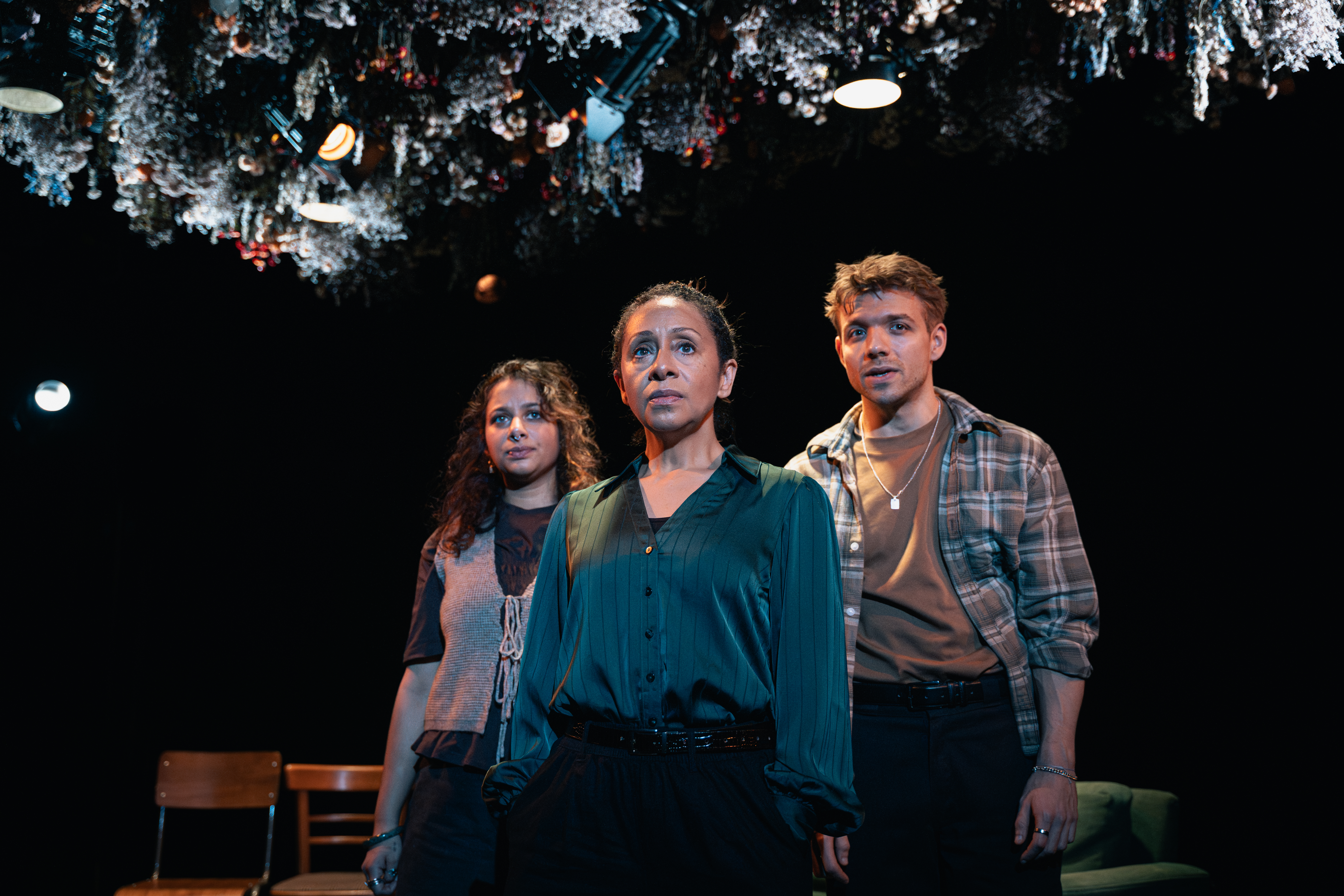
London’s Bush Theatre celebrates the world premiere of Farsh Najib’s existential play. Guillermo Nazara conducts a post-mortem on the show to let us know if any element of the plot comes off rotten.
I’ve always thought that the Joyce Vincent case would make a fabulous play. For those unfamiliar with the name or her story, this middle-aged North Londoner was found dead in her Wood Green bedsit over two years after her passing. During that time, hardly anyone had noticed her absence.
Her neighbours rarely interacted with each other, and they assumed that the decomposing odour came from a nearby dumpster. She had severed all ties with her family as well. And although they had hired a PI to track her down, her lack of response, due to her unknown demise, made them assume she didn’t want to be contacted.
Two questions pop up surrounding her death. One is obviously the cause, which can only be assumed (maybe asthma or complications following a peptic ulcer operation). The other, which is certainly more fascinating, is who the half-wrapped presents under her Christmas tree were for?

You might have got goosebumps from that last line. And why shouldn’t you? It’s a stirring, haunting concept for a narrative. I would hold my enthusiasm, however. Despite its evident influences, which aren’t at all referenced, this piece discards the most arresting elements of its source of inspiration. And the result isn’t that grave.
Her name is Shirley, and her neighbours do care about her. Or at least, they do enough to worry about the smell. There’s a stench permeating the walls of a so-called “small residential block in an unremarkable corner of London”. So far, it isn’t putrid, but despite its sweet pungency, it has the scent of death. They suspect it’s coming from Flat No. 61 — they haven’t seen Shirley in a long time, and she wouldn’t reply to messages or even the banging on her door. She may have left and told no one. She might as well be on a long vacation. Yet, that seems improbable. It might be just a strong hunch — or maybe the fact that so many other apartments have been pestered with maggots.
Different lives intertwine across this choral recount — young students trying to find their paths, hardworking parents with big dreams for them, and solitary people living through the memories of a time that’s no longer there. The point is simple: existence is finite, and as such, it should never be taken for granted. An even bleaker message pervades its reading: we are all disposable pawns in this world, and no matter how highly we think of ourselves, it will turn with or without us.
It’s a brutal cautionary tale, but an important one anyway. And that’s something we can appreciate in Farah Najib’s writing. We can also acknowledge her beautifully executed novelesque style, which excels through the use of vivid, descriptive language. And we could give some credit to the piece’s adequate dynamism, which is achieved by reducing the cast to three raconteurs swapping all the characters. That’s the extent of it, though.
It’s not enough. And it doesn’t take many pages in the script for us to realise that. The idea is solid. The approach, nonetheless, is wrong.

The text intends to encompass too many subplots in roughly an hour. Suffice it to say, it fails in that attempt — not miserably, not catastrophically, but still prominently. There are so many roles navigating their own personal difficulties. And yet, not a single one is given the opportunity to explore them deeply enough to resonate with the viewer.
It might be the author’s conscious decision. Much like the idea the piece introduces, no personage is more important than any other. In fact, nobody is important at all. Philosophically, it makes sense — but it’s a poor dramatic choice, and it rarely leads to a successful outcome.
They could have still delivered the same message through a different focus, and it would likely have been more effective. Shirley is treated like a framework device instead of the show’s protagonist. There’s nothing more tragic than present someone as special, only to reveal how little relevance she’s had anywhere she’s been.
We could have celebrated her. We could have been enraged with impotence by the solemn circumstances surrounding her departure. And ultimately, we could have been inspired to look forward instead of dwelling on what’s forever gone. That never happens, though. No true emotion ever happens.
It is an entertaining journey, but not without its bumps. The pacing is steady, for the most part. Yet, some segments feel stagnant and lose their engagement for quite a while. The ending is also unsatisfactory. It doesn’t imbue as it should nor as it thinks it does. We should be besieged by its final words. Instead, apathy is the common reaction.

The structure doesn’t contribute to the recount’s appeal either — on the contrary. We can anticipate the show’s conclusion by the moment the premise is established. Consequently, it feels absurd to spend an entire hour just to be told something we already know, as there is no actual reward to our investment.
Overall, the company is competent. Their renditions demonstrate rapport, decent naturalness, and sufficient yet not outstanding register. So is the staging, whose bareness (a black box with only a chair and sofa for props) still paints a few vibrant pictures, although the herbs masking the lighting grid seem to serve no further purpose than being merely decorative. The blocking is generally well put together, too, with the exception of a few pointless aisle strolls.
There’s an eerie sense of serenity to Joyce Vincent’s portrait, whose image inevitably kept popping into my mind as the play unfolded. Her story is the story of a million forgotten people. The story of a million unrealised dreams. And the story of a million dramatic possibilities, none of which has truly been explored throughout this piece.
Although there’s an intellect and a pulse, the heart and soul of what this work should have been about and for is completely absent. And much like with the inhabitant of No. 61, all that we can do is keep going and not think too much about it.
This site is proudly sponsored by

Help us continue our work
We count on your support to keep bringing the greatest quality in theatre-related content, from interviews with the biggest names in the industry to reviews of every show in town and beyond.
We appreciate every donation to maintain our high pace and standards and continue to grow.
Thank you for believing in us!
***************************************************
All pictures credit to Ross Kernahan.
Maggots plays at London’s Bush Theatre until 28 February. Tickets are available on the following link.