
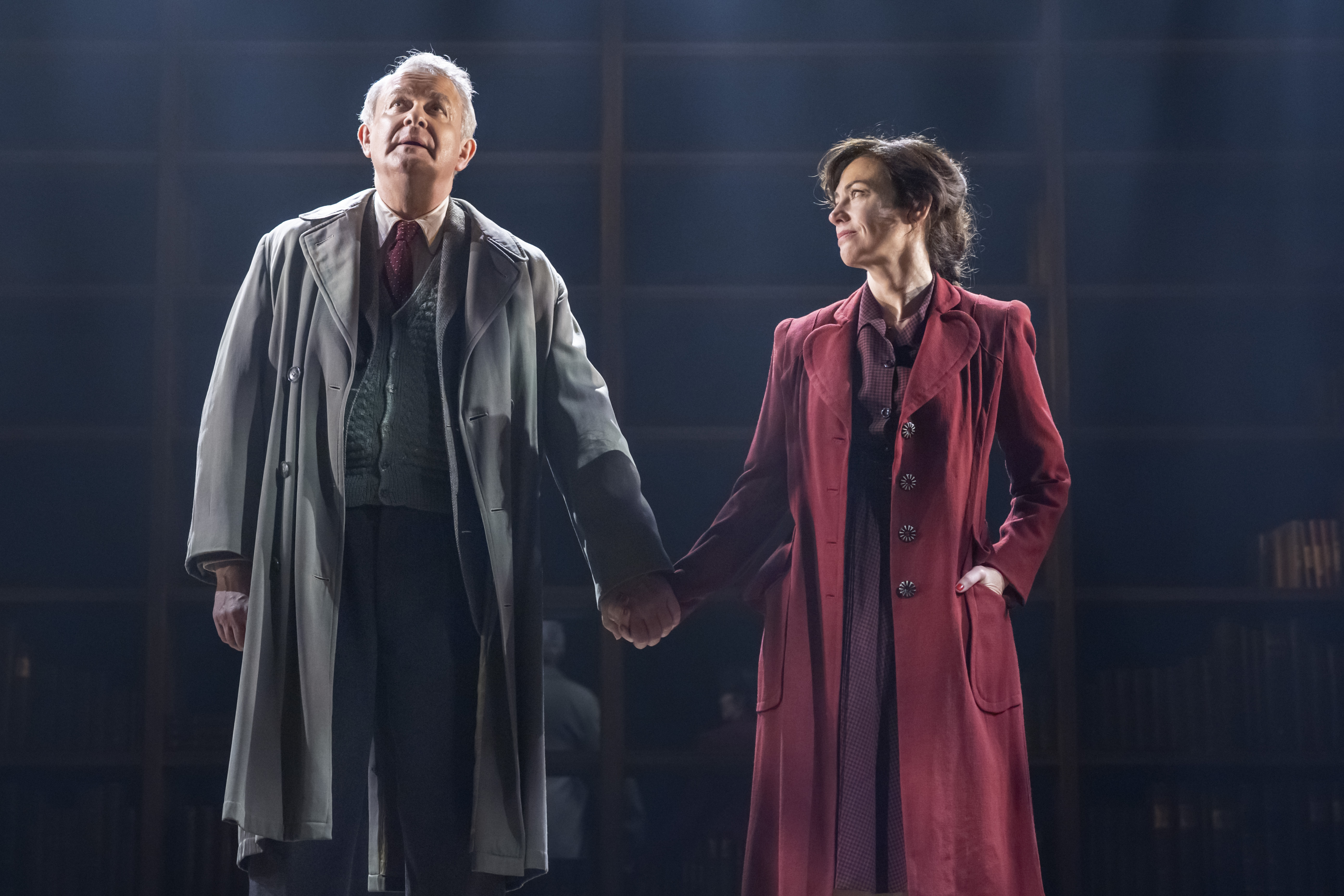
London’s Aldwych Theatre hosts the West End revival of William Nicholson’s play, which explores the real-life romance between C.S. Lewis and Joy Davidman. Guillermo Nazara shares his views on the show to let us know if its value is all due to an experiment of criticism.
I may just be a contrarian, but I don’t understand the fascination this play has generated — in some, that is. Everyone is entitled to their opinion. And I certainly have a strong one about this piece. Yet, I wonder what it is that they found so moving, even cathartic, in a narrative that, for the most part, is missing some vital components to function.
An assertive C.S. Lewis, portrayed by Hugh Bonneville, steps onto the stage, unannounced. A profound speech about God’s existence follows. In a world plagued by suffering and injustice, the idea of a loving, almighty deity becomes questionable. Lewis doesn’t doubt his faith, however. Life on earth is a shadow of the real one, as he puts it. It’s the dark path that leads us to the shining glory of heaven.
We would expect an analogical situation throughout the evening. The characters experience it within the narrative — vacuously, but that’s another subject to tackle later. The same doesn’t apply to the viewers, however. There is shade, but hardly any light. And in the end, we are presented with an underdeveloped recount that feels obscure and obfuscated.

It’s not difficult to understand. There is not that much to grasp in the first place, either. And that is the problem. C.S. Lewis’s factual romance with Joy Davidman, an American fan and fellow wordsmith, is a concept that overflows with opportunities for poignancy and profundity. Sadly, the script doesn’t take any of them, as it barely scratches the surface and extracts next to no substance from them.
You may pardon the cliche, but it’s only appropriate to say that a tale like this writes itself. That might be what makes its lack of pathos more unforgivable. She was a struggling mother escaping from a loveless and abusive marriage. Upon relocating to the UK, she finds solace in meeting her literary hero. Courtesy evolves into friendship. And not long after, friendship turns into something else.
We should be captivated at this point. Or at least, it should have stirred us somehow. Yet, the text doesn’t deploy its resources properly. Overall, the pacing is flawed. The scenes are rushed and slightly inelaborate. And so is the plot, whose execution is cursory and faulty.
The play doesn’t make it easy to care for the personages’ journey. Their relationship isn’t explored in a compelling manner, and audiences aren’t given the necessary tools to bond with it. Everything unfolds way too quickly. At the start, they are pen pals. A few moments later, they get married. And roughly two or three scenes afterwards, we find out she is dying of bone cancer.
There is not enough space to digest such a dramatically rich story. We know what happens, but we don’t know who it’s happening to. Despite their real-life origins, the characters look shallow, sterile, and artificial. There are no traits in them that grant them sufficient humanity or individuality. And apart from Lewis’s theological reflections, there’s no actual introspection to let us feel for their plight.

The production is decently put together, but that doesn’t make it impressive. While the staging is aesthetically pleasing and somewhat intricate, it doesn’t display the dynamism or versatility needed to meet the recount’s demands.
A group of library shelves serves as the show’s permanent scenography. Occasionally, the ones in the background would slide open to reveal a whimsical landscape inspired by Lewis’s oeuvre, which a downstage streetlamp gives another nod to. A revolving platform and a few additional sets complete the design — it’s beautiful to look at, but it’s not as efficient when it comes to evoking several settings.
Hugh Bonneville gives a fine performance as C.S. Lewis, but sadly, that is the extent of it. His portrayal teems with the poise and technical command of an established theatre actor, but when the role becomes more challenging, he struggles to keep control of it. His rendition isn’t layered enough, with some excerpts feeling mechanical and vaguely credible.
Maggie Siff co-stars as Lewis’s love interest, Joy Davidman. And although there is some sporadic flair, most of her interpretation falls flat and doesn’t ooze much magnetism. Consequently, Lewis’s fascination with her character becomes even less understandable. And that flaw is accentuated by their noticeably low chemistry.
They talked a lot about God. Yet, that hardly led to a divine time at the theatre. Shadowlands has made its way back to the West End, and its apparent success at the box office indicates it’s been the right commercial decision. Yet, from an artistic point of view, the piece doesn’t answer many of our prayers. It doesn’t give us enough reason to believe or endure through it. And ultimately, its potential remains in the dark.
This site is proudly sponsored by

Help us continue our work
We count on your support to keep bringing the greatest quality in theatre-related content, from interviews with the biggest names in the industry to reviews of every show in town and beyond.
We appreciate every donation to maintain our high pace and standards and continue to grow.
Thank you for believing in us!
***************************************************
All pictures credit to Johan Persson.
Shadowlands plays at London’s Aldwych Theatre until 9 May. Tickets are available on the following link.