
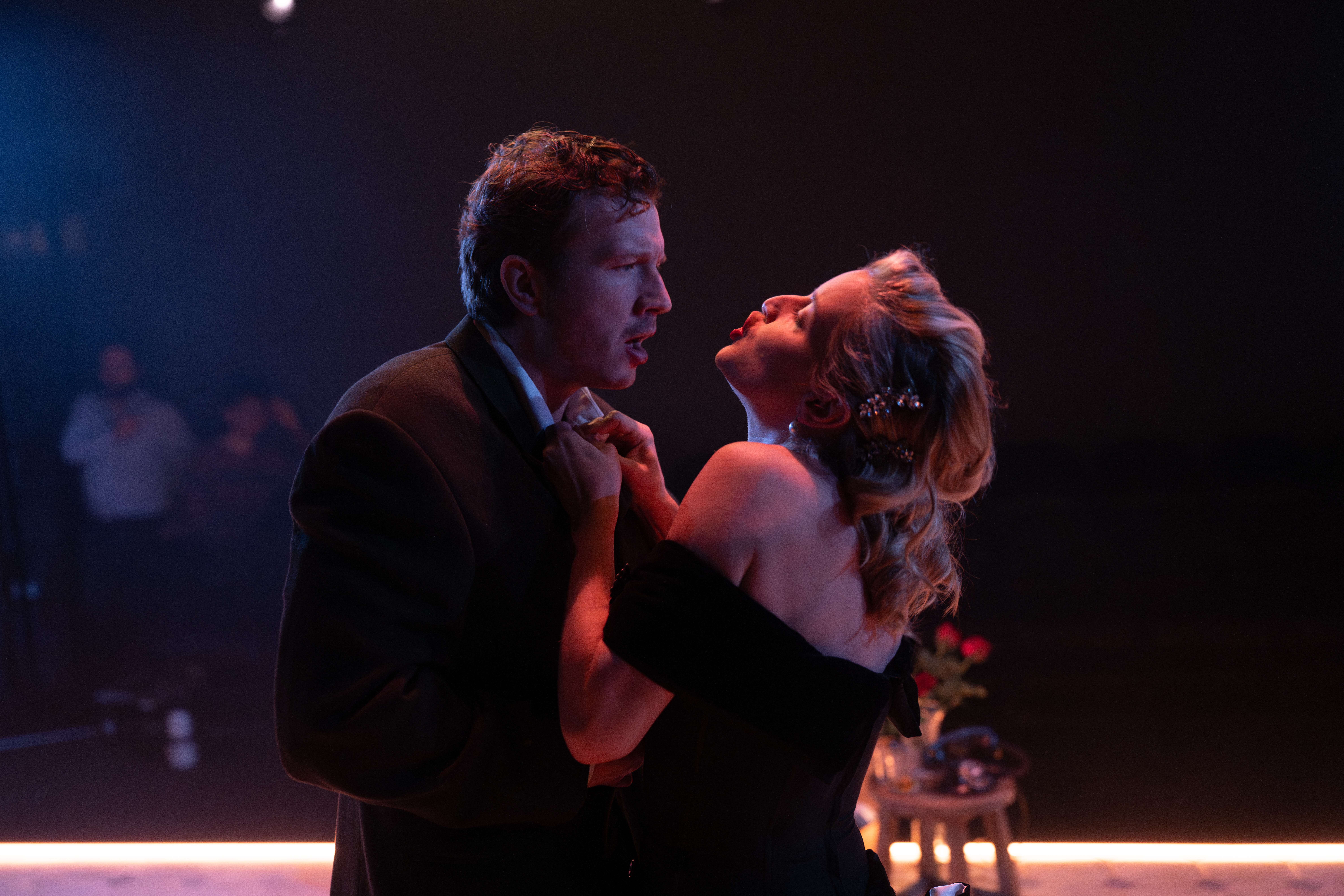
London’s Park Theatre presents Patrick Marber’s period drama involving a dangerous affair. Guillermo Nazara shares his views on the show to let us know if there’s anything to love about this torrid romance.
She may have swept the floor, but she couldn’t sweep an audience away. That wasn’t Miss Julie, however, but her devoted maid, Christine. She didn’t make a lasting impression either. Or at least, she wasn’t a memory worth keeping. Nothing in this play actually was. From its unresolved narrative to its pushful attempts at shocking, the only thing that After Miss Julie accomplishes is heightening its competitors’ value.
It’s just too dramatic. And surprisingly, there is no real drama at all. Not in a way that feels transfixing to the viewer, that is. Even if you’re looking for a soap operatic plot where juicy action replaces insight and logic, you might be disappointed. Structurally flawed, its frustrating pacing and limp storytelling make this piece anything but a fine watch.

A faithful servant eagerly awaits her wedding day. Her fiancé, John, has just returned from war, and exciting times lie ahead upon Labour’s victory in the 1945 election. The lord of the house is a prominent member of the party, and he has made John his right-hand man. It seems like, from now on, everything will be fine. That is, of course, until she arrives.
Miss Julie, the boss’s daughter, has envisioned a different life for herself. And that involves bringing somebody else along — and leaving someone behind, too. She is a grown woman now, and she still remembers the way John looked at her the first time they met, when they both were just children. Casual talk unfolds. Some not-so-subtle innuendos. It doesn’t take long for their passion to be unleashed. Cunning, lust, and mischief intertwine in a dangerous liaison with inevitably dire consequences — for everyone.
Once again, we’re witnessing a case of a strong premise weakened by a clumsy delivery. Writer Patrick Marber might know what he wants to tell, but he doesn’t seem as knowledgeable about how to tell it, let alone make it work.
Every aspect of it is overwhelmingly vapid. From an underdeveloped exposition resulting in massive archetypes to a rushed exploration of its conflict, the play fails to grip its audience. All in all, it’s a roughly drafted idea yearning for elaboration. There is promise, but not realisation. And in the end, its potential drowns in a melodramatic execution saturated with confusing turns and inconclusiveness.
For the most part, the characters do not behave according to their instincts, but rather for the convenience of the script. Their conduct comes across as artificial, as their temperament swings too swiftly and drastically to be credible. There’s hardly an arc for any of them, and their relationships are treated superficially despite being the recount’s most pivotal component.
Even from an action perspective, the narrative is quite flawed. It teases us with probable outcomes that never materialise. And instead, it takes forever to reach a point we could see from the very start. All the rest is just a futile effort to disguise its lack of substance. A bird is decapitated, and its blood is splattered across John’s face in what should be interpreted as a display of femme fatale eroticism — but which, in reality, is just ridiculous.

The script combines overly long sequences, where virtually nothing happens, with excessively intense moments that escalate too fast to be accepted. At the same time, the dialogue doesn’t sound genuine. Although it’s aesthetically pleasing, there’s too much ornamentation, even for a period narrative. Consequently, its authenticity fades. And inevitably, its impact is minuscule.
We can find redemption in both the staging and some of the performances. Eleanor Wintour’s in-the-round design creates a compelling sense of immersiveness, and its figurative, historically accurate approach effectively transports audiences into the 1940s era. Simultaneously, Tom Varey and Liz Francis shine in their portrayals of John and Julie, which brim with magnetism both individually and towards each other.
She might be an enchantress, but none of her charm is captured in this overall dull and unappealing story that barely justifies its existence. After Miss Julie could have been thrilling, piercing, resonant, and even thought-provoking. Instead, it offers an unfinished replication that doesn’t add any excitement, novelty, or value. Après lui, le deluge — but it’s the entertainment that gets destroyed.
This site is proudly sponsored by

Help us continue our work
We count on your support to keep bringing the greatest quality in theatre-related content, from interviews with the biggest names in the industry to reviews of every show in town and beyond.
We appreciate every donation to maintain our high pace and standards and continue to grow.
Thank you for believing in us!
***************************************************
All pictures credit to Teddy Cavendish.
After Miss Julie plays at London’s Park Theatre until 28 February. Tickets are available on the following link.