
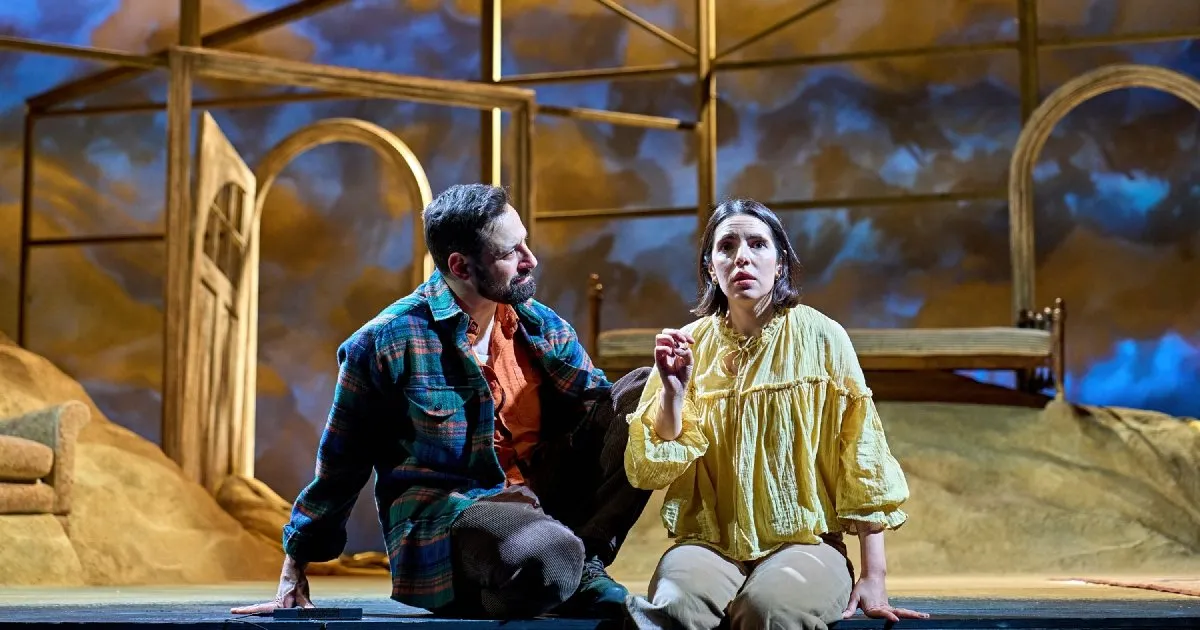
Christy Lefter’s popular novel returns to the stage through this touring adaptation produced in collaboration with the Nottingham Playhouse. Guillermo Nazara shares his views on the show to let us know if it’s bound to make the theatre colony buzz.
I wanted to cry. I wanted to be moved. Sadly, my wishes weren’t granted. I was taken on a journey, but that’s just because I let my mind wander. And so it did — far greater lengths than the ones travelled by the show’s protagonists. In a time of blazing global turmoil, the stage adaptation of Christy Lefter’s novel, which depicts the almost superhuman fight for survival of Syrian refugees, seems like the right fit in today’s repertoire. And it is. Its premise is. Its dramaturgy, however, cannot claim amnesty.
It’s a remarkable story defined by grief, loss, and unbelievable strength. Innocent people are forced to leave everything behind to secure the slightest chance to live. It’s an ordeal by fire; audiences should be gripped and destroyed by it. Yet, our reaction to its rushed, superficial script leaves us indifferent to a plight involving so much suffering.

There is no poignancy despite all the terrible things the personages endure. Barely any other narrative presents us with a character going through as much as Nuri, who must do everything and more to make his way to the UK and escape the horrors of war. Close relatives die. His wife is raped, and the stress of the war causes her PTSD-related blindness. He is forced to undergo the most dangerous endeavours for the safety he so desperately craves. And yet, as viewers, our attitude couldn’t be more impassive.
Overall, it’s a flawed script. The focus is set on the wrong sections of the story. Some pivotal elements are reduced to mere mentions, while the most banal take over the spotlight for far too long. Many opportunities for a harrowing portrayal are lost, where audiences could have experienced the same pain, frustration, and desolation Nuri faces. Yet, instead of showing us what it’s really like, the text delegates the task to trite dialogue with no potency or stirring quality.
The beginning suffers from excessive, sometimes pointless exposition, which inevitably contributes to the generally stagnant pacing in some scenes. Some other segments, particularly during Act Two, are the exact opposite, but their damage to the piece’s impact is just the same. And in the end, although it does bring up a few thought-provoking themes, its emotional layer is so thin it can hardly be noticed. And at some moments, it’s simply not there.
The staging is dynamic and moderately versatile. Nonetheless, its functionality isn’t as broad as the narrative demands. Ruby Pugh’s design comprises a still set of limestone walls and dunes, where doors and windows turn into any aspect of reality required. Sometimes, it works. On some others, it lacks care. And too often, it looks clunky.

Adam Sina gives an adequate performance as Nuri, whose heated approach is admittedly its most robust feature. However, there is not enough nuance or intricacy in his execution. Consequently, his interpretation is too one-dimensional despite the character’s evident complexities.
Some ensemble members exhibit more resourcefulness. Joseph Long and Aram Mardourian’s multi-role performances showcase range and spontaneity. And although some traits could benefit from some additional polish, the final impression is rather satisfactory and occasionally praiseworthy.
On the contrary, Farah Saffari’s performance as Afra (Nuri’s wife) is extremely weak, defined by her inability to convey any authentic sentiment. The result is a flat and unappealing delivery, where any possibility of connecting with her character is completely blocked out.
True art is said to be divisive. If that is the case, The Beekeeper of Aleppo has chosen the right topic at the most perfect time. Nonetheless, despite cross-pollinating some stimulating ideas, its clumsy, somewhat inexpert development- where the pathos never materialises, and the overall recount feels remarkably vapid -has put most of its nectar to waste. Naturally, it can’t be considered the bee’s knees.
Help us continue our work
We count on your support to keep bringing the greatest quality in theatre-related content, from interviews with the biggest names in the industry to reviews of every show in town and beyond.
We appreciate every donation to maintain our high pace and standards and continue to grow.
Thank you for believing in us!
***************************************************
The Beekeeper of Aleppo is currently on tour across the UK. Tickets and venues are available on the following link.