
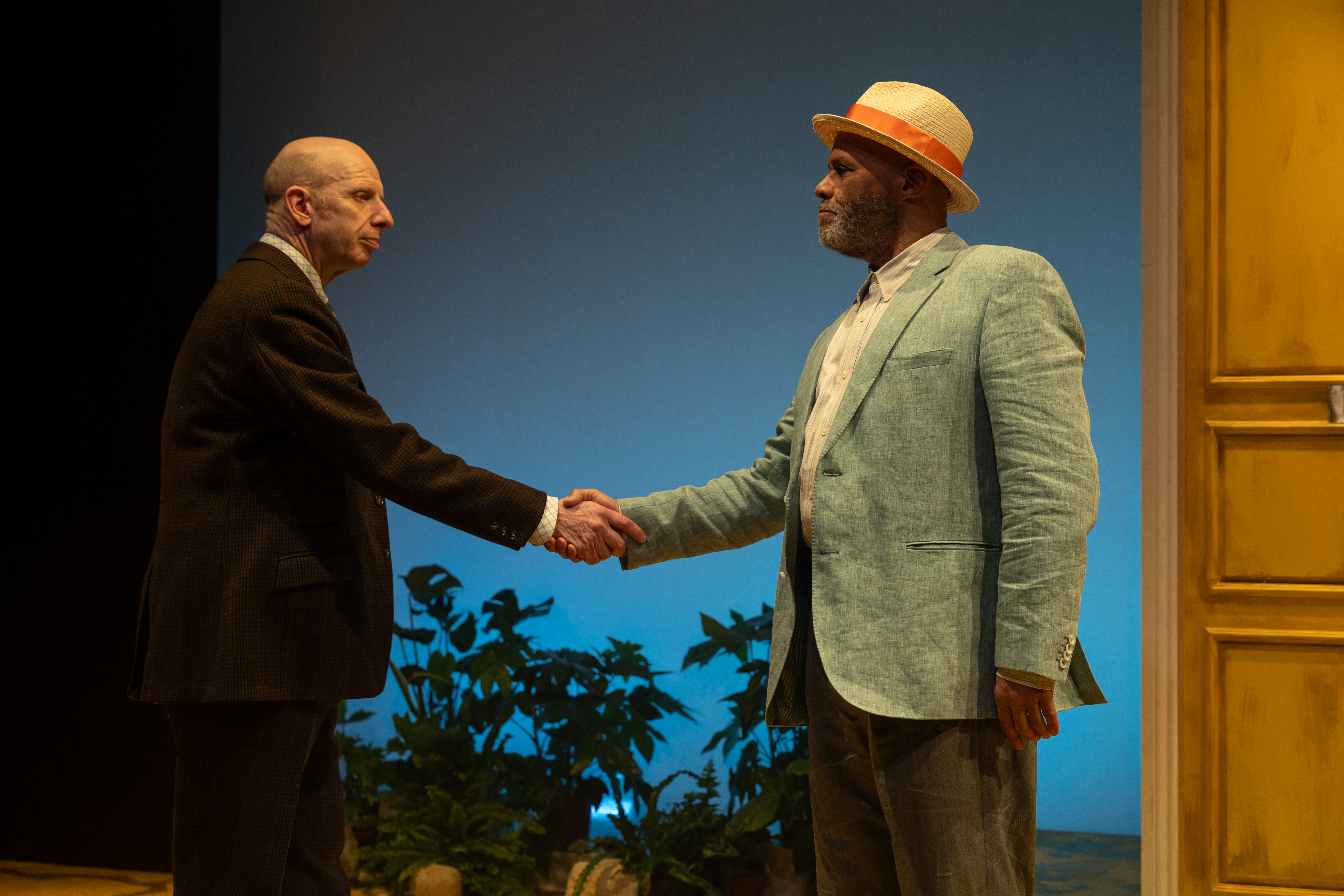
Gary Wilmot and Steve Furst reunite onstage through this philosophical play exploring different layers of the human condition. Guillermo Nazara shares his views on the show to let us know if its Samuel Beckett-inspired style will grant the run a few happy days.
He’s an excellent actor. So is his co-star. And his admiration for Samuel Beckett’s style is evident in this existential two-hander, where nothing much happens except for the characters’ eternal rambling. Much like its themes, the title doesn’t lie too far from its predecessor. If Beckett gave us Waiting for Godot, Wilmot has come up with While They Were Waiting, a name that effectively alludes to the passing of time, no matter how painfully slow that is.
A yellow door stands centre-stage. A fine-looking gentleman hastily rings its bell. There’s no answer. A random man passes by and instantly engages in conversation. They talk about everything. And I mean everything — and the meaning of everything. A lengthy linguistic discussion unfolds, which could have served as a starting intellectual stimulus — but, in reality, it is just as evident as the rest of the play.
It pretends to be deep. It attempts to become it. Yet, in some way, it’s an aphasic concoction. Elementary philosophical notions are presented through overflowing word loads. They hopelessly try to convey the idea of profundity. In reality, all its conclusions are either obvious or banal.
Consequently, audiences aren’t taken on a journey of discovery. Or on any kind of journey at all. Not only is the play unable to offer us a comprehensive look into the human condition, but it also struggles to evolve on almost every level. Inevitably, the script fails to engage, as the characters’ sketchy arc isn’t appealing enough to entice us, let alone hold a grip.
There is a layer of pathos — but once again, it’s too thin to make an impact. Although its twist ending is conceptually powerful, the execution doesn’t honour its potential. Gary Wilmot’s exquisite performing skills, flaunting an unequalled degree of authenticity and heartfulness, help counterbalance the writing’s emotional deficiencies. However, the uncanny effortlessness in his interpretation can’t disguise the text’s prominent shortcomings in that department — or any others.
Steve Furst generally matches Wilmot’s performative energy and competence through an upscale rendition infused with dry humour. The chemistry between the two solidifies instantly, and it’s admittedly the production’s most laudable feature alongside Hannah Danson’s stunning set design, whose visual vibrancy and overall intricacy are an utmost triumph from both an aesthetic and functional perspective.
We can argue that play’s contemplative nature may not attract everyone. Yet, even those craving a metaphysical recount, with no more action than a few theoretical observations, may feel disappointed by its scarce substance and unfulfilling development. That onstage door does open in the end, but too many others have locked its narrative chances away.
Help us continue our work
We count on your support to keep bringing the greatest quality in theatre-related content, from interviews with the biggest names in the industry to reviews of every show in town and beyond.
We appreciate every donation to maintain our high pace and standards and continue to grow.
Thank you for believing in us!
***************************************************
While We Are Waiting plays at London’s Upstairs at the Gatehouse until 22 March. Tickets are available on the following link.