
Following the success of its original Broadway run, London’s Royal Court presents Kimberly Belflower’s modern exploration of Arthur Miller’s classic. Guillermo Nazara shares his views on the show to let us know if its execution is hanging by a thread.
I still think Abigail Williams is the bad guy. In other words, we could confidently say she’s the biggest witch of her era. For those unfamiliar with Arthur Miller’s dramaturgical tour de force, this reimagined historical character was responsible for the deaths of so many innocent people- primarily, women -who were wrongly accused of siding with the Devil.
The real events did not involve an obsessive liaison with fellow Salem townsman John Proctor, a man 50 years her senior (contrary to her fictional counterpart, Abigail was actually twelve when the accusations took place), and whose martyr-like death granted him a position in the pantheon of American Literary heroes.
There is a reason why the role is so compelling. And it’s perhaps the same that has instigated a few revisionist takes on the material, starting with Kimberley Belflower’s play, whose success in the New York scene has secured it a spot in London’s Royal Court’s promising 2026 season.

None of the characters is a saint. And none is the quintessential embodiment of evil. Still, balancing their flaws and virtues is crucial to determining who we should root for. Miller’s Proctor was in his mid-to-late thirties when he had an affair with a seventeen-year-old Williams. Cheating on his wife was wrong. And to those oblivious to the societal norms of the time, so is the age gap.
Still, he tries to make amends by severing all ties with Abigail, who, in return, gathers a slave and a few girls from the village to perform a magic ritual in the woods, drink animal’s blood with the intention of hexing Proctor’s wife, Elizabeth, to death. When Reverend Parrish discovers them, she goes to even further lengths and frames Elizabeth as the real witch, leading to the execution of 19 people, not even showing the slightest remorse for the consequences of her actions.
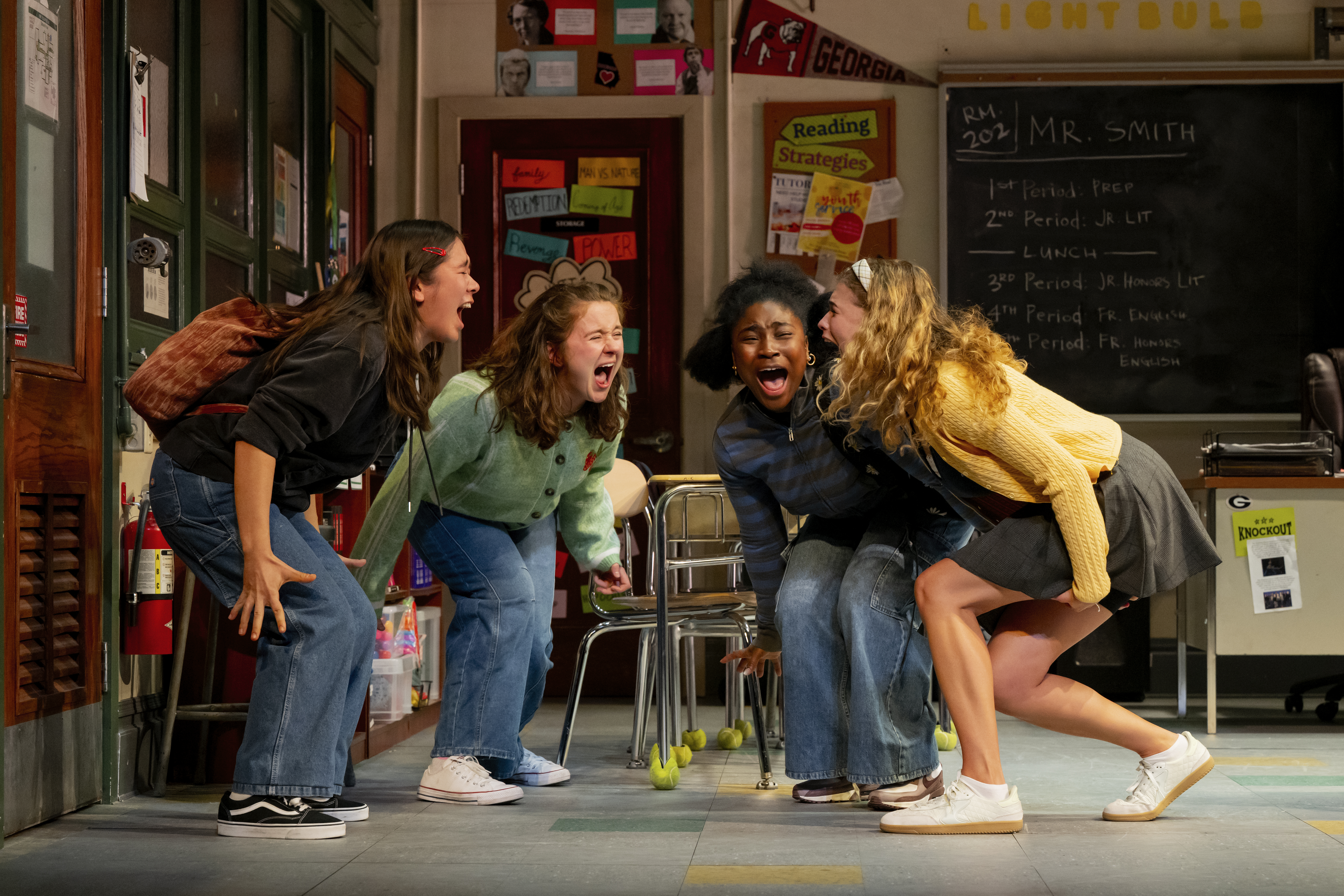
It doesn’t take much effort to ponder whose moral compass points in a more wholesome direction. Apparently, that doesn’t matter throughout this play, whose conclusion features two teenage girls portraying Abigail and Elizabeth making peace with each other and initiating a tribal dance where all the students join against their allegedly predatory teacher.
The correlations are evident. And the message is clear. There is nothing intrinsically wrong with its topics. It’s the approach to them, in addition to a vacuous character development, that makes the piece problematic and, eventually, unfulfilling.
In a rural town in Northeast Georgia, Mr Ebert is considered the coolest teacher in high school, with a reputation Dead Poets Society Robin Williams could only dream of. All his female students have a crush on him. They adore his charisma, his inviting attitude, his charm and friendliness, and count on him for whatever they need. They’ve also seen him in sweatpants, which has helped solidify, if not hardened, his popularity.

Yet, not everything is as idyllic as their romanticised educator. One of his students, Raelynn, has been in a feud with her former bestie, Shelby, since she slept with her boyfriend, Lee. Lee still wants Raelynn back, and he can’t accept the fact that their relationship is over — nor can he respect her boundaries.
At the same time, everyone sees Shelby as a weird outcast no one wants to be around anymore. She has been absent from school for several months. And that’s been the subject of much speculation. However, nobody could anticipate the real cause of her departure. And upon her return, things take a much more obscure turn.
Belflower’s writing demonstrates sharpness and flow. Overall, the dialogue is well-crafted. There is cadence, potency, and moderate subtext. The same applies to the script’s pacing, which generally moves at a steady rhythm and preserves its grip for most of the recount. And on the whole, it’s a thematically strong premise with an engaging delivery and an adequate structure — as long as they don’t mind some of its elements falling apart.
Despite its robust foundation, the play doesn’t convey the nuance and depth of Miller’s allegorical masterwork. Although the story is entertaining and its notions resonate with today’s morals, some aspects of it are heavily underwritten — a demerit that affects most of its characters primarily.
There is a transformational process for Raelynn and Shelby. Understandably, the focus of the show should be drawn onto their journey and their relationship. That’s not a blemish. The rest of the cast, however, is, as it comes across as archetypal to a greater or lesser extent. Lee is reduced to a self-entitled bully who can’t see past the end of his nose — and something else. His mate, Mason, is a thicky, thicky dum-dum with a heart of gold. Beth is basically a comic relief student role with sapiosexual issues. And their young guidance counsellor, Bailey, has as much personality as Frank Wildhorn’s music.

There is a need to expand a concept that, while striking, is nonetheless rushed and somewhat shallow. Ultimately, many personages aren’t complex enough. They stand for an idea, and they get stuck in it. There’s no real arc for any of them. And when there is, it’s extremely vapid.
There are some exceptions, which come from a few satisfactory side plots. Maggie Kuntz, another close friend of Raelynn’s, struggles to think of her father the same way after some concerning allegations. However, her path is sketchily put together. And it’s these unfinished components that eventually compromise the narrative’s impact, making its thought-provoking qualities evaporate.
The acting is robust and highly praiseworthy. Some subtle stroke of farce complement an overall naturalistic interpretation. On the whole, the cast brims with organicness, presence, and chemistry.
Dónal Finn earns a first mention as George Ebert, whose performance effectively conveys a sense of duality between the character’s overly nice facade and the monstrous inside he supposedly conceals. At the same time, Sadie Soverall shines through her impeccable rendition as Shelby, masterfully capturing the role’s clashing essence, where frailty and aggressiveness coexist in an ongoing conflict.
Some audiences will find an immediate connection with this play. Some of them might instantly repel it. Regardless of its political reading, John Proctor Is The Villain shows the potential but not the means to become a magnum opus of societal commentary.
Although the plot is absorbing and the writing displays deftness, its embryonic dramaturgy makes it a passable but not remarkable experience at the theatre — and in no way matches the excellence of Miller’s enduring work. If they had played the devil’s advocate a little more, the show would have been a much bigger intellectual accomplishment. So far, it remains in a trial state.
Help us continue our work
We count on your support to keep bringing the greatest quality in theatre-related content, from interviews with the biggest names in the industry to reviews of every show in town and beyond.
We appreciate every donation to maintain our high pace and standards and continue to grow.
Thank you for believing in us!
***************************************************
All pictures credit to Camilla Greenwell.
John Proctor Is The Villain plays at London’s Royal Court Theatre until 25 April. Tickets are available on the following link.