
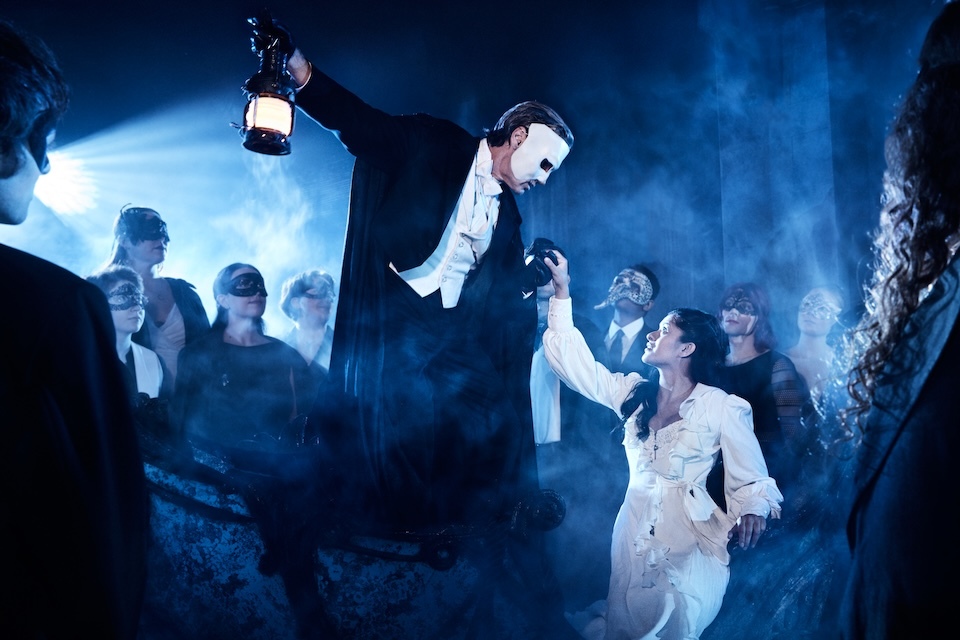
Anyone reading this review remembers the strange affair of the Phantom of the Opera. And the reason for its success is no mystery needing to be fully explained. That is, perhaps, with the exception of those behind its New York City resurrection, which, despite the hype it’s gathered over the past few months since its recent opening, has proven to be a complete misunderstanding of what made its first incarnation worthy of the “brilliant original” title.
If you’re one of the show’s loyal devotees, to the point that you call yourself a phan and its protagonist Erik, there are two possible outcomes upon walking through this nearly two-hour reimagining of Andrew Lloyd Webber’s consummate effort. You can either ignore all the flaws and be content that your favourite score is still playing (pre-recorded, that is) two streets away from the Broadway district, or you can take on a more critical tone and acknowledge that, had this version be the first West End audiences encountered back in 1986, we would not be celebrating its 40th anniversary in London this year.

There had already been two trainwrecks concerning the Opera Ghost’s legacy, which the quality of Harold Prince’s vision (we shall delve into that further on) has overcome masterfully. The first was Joel Schumacher’s infamous movie adaptation, which, I must admit, I don’t dislike as much as I’m supposed to (I discovered Phantom through it, and for that, I shall always be grateful). Then again, once you’ve seen the stage show, you don’t need to be reunited with the picture ever again — or Gerard Butler’s singing.
The second was the futile attempt to expand a story that didn’t need any additions, and whose choice of moving the Phantom from the allure of late 1800s Paris to the garishness of turn-of-the-century Coney Island felt clumsy and inappropriate at the very least. A so-called hate group named Love Should Die followed the decision. And understandably, the piece was nicknamed Paint Never Dries.
For some inexplicable reason, those seem to be the main sources of inspiration for director Diane Paulus’s lackluster approach to Webber’s Victorian melodrama, where the work has actually reconnected with its roots — not the ones at His Majesty’s or the Majestic, but the Sydmonton first draft and the penny-dreadful era Gaston Leroux’s faction novel was born into. The name of the period says it all.
Fortunately, the disappointment doesn’t hit from the get-go. In fact, the initial scenes are adroitly put together. A virtuoso violin suite (the only excerpt of live music featured throughout the entire rendition) welcomes guests into the venue’s catacumbal mystique.
A song cycle starting and ending with Christine’s journey to the cemetery is succeeded by the entrance of the enigmatic Madame Giry, whose portrayal is influenced by Miranda Richardson and Liz Robertson’s confusing French-accented interpretation — they all live in Paris, and most of them are French, so what’s the point in only one character speaking that way?

After teaching visitors a few simple moves before stepping into the impending masked ball, Webber’s tuneful Act-Two opening unfolds in full glory. There’s spectacle, there’s vibrancy, and there are some not-so-adequate new lyrics. Still, the performance sings and dances to the delight of all the attendees. From then on, the plot starts to develop. The spine-tingling overture plays, as the chandelier, already hanging from the rafters, rises moderately into the ceiling, and the Hannibal rehearsals follow.
That entire first section respects and captures the sparkle of the original deftly enough. And if it weren’t for Kaley Ann Voorhees’s annoyingly distraught take on Think of Me, it would have been close to a perfect execution. The problems unravel right after, as audiences are taken down an escalator into the Phantom’s lair. Dry ice, scattered candles, and a slightly cartoonish appearance- somehow closer to the glam-rock promotional video starring Steve Harley -confect the antihero’s shelter, where a Viking-looking gondola slides into a stony pedestal designed to accommodate the Music of the Night number.
From then on, the cracks begin to show, and they broaden with every scene. Their determination- probably stemming from panic -not to replicate any element from Gillian Lynne’s sumptuous choreography is evident. And their solution only reinforces her status. Instead of the evocative gestures that have built part of the piece’s visual signature, a wide-eyed Christine lies on the floor as the Phantom chants his most seductive tune, only to be carried into the bedroom in his lap. Not a lot of subtlety. And definitely no elegance whatsoever.
As the show progresses, it becomes the exact opposite of what Harold Prince, who we all wish were somehow here again, wanted it to be — and the main reason why he refused to attend the Sydmonton Festival tryout. Eventually, the camp takes over. Many scenes remain — with a few questionable alterations. And the same happens to most of the repertoire, including the film’s Oscar-nominated song Learn To Be Lonely — but it’s not the same by any chance. In the end, the whole thing looks comical, over-the-top, and extremely shallow.
Despite its endeavours to infuse the narrative with poignancy, the recount comes off flat and sterile. Once again taking inspiration from Schumacker’s screen version, a young, carny Erik takes audiences on a trip down memory lane, where we witness his traumatic past, when he was forcibly displayed as a human oddity for the patrons’ amusement.

Although conceptually powerful, the pathos doesn’t imbue its delivery. There’s too much emphasis on entertaining guests with side numbers rather than focusing on the protagonist’s plight. Inevitably, his horrible situation doesn’t strike as hard as it should. We can be enticed by his journey, but not really invest ourselves in it — simply because its resonance is practically nonexistent.
Nik Walker’s sloppy acting is a major contributor to the performance’s impassivity. Albeit he demonstrates competent vocals, his portrayal is extremely dull and one-dimensional. There’s no sentiment to it. And no nuance or understanding of the Phantom’s nature either. When he’s not behaving like Batman‘s Joker- his shrill laughter could pass for an old hag’s cackle- he plays a histrionic, superficial character that stands closer to a Marvel Comics supervillain, rather than the complex, troubled soul that makes the role so harrowingly appealing.
Kaley Ann Voorhen’s interpretation at least encapsulates Christine’s essence on a higher level, honouring the novel’s description of a budding adult soprano with a heart as pure and innocent as a sixteen-year-old. Her singing is decent, but the excessive use of portamento and sweeping leads to a few out-of-tune fragments.
Her main flaw stems, once more, from the acting. If Walker’s approach is frustratingly apathetic, her rendition seems stuck in a meltdown mode, where everything she does, experiences, or says is either triggered or supported by a nervous breakdown. Yes, she’s been through a lot — but she’s supposed to go on an emotional roller coaster, not being trapped in an endless loop of mental derangement.
The rest of the cast- who, unlike the leads, will probably be the same troupe regardless of the time slot -deliver a far more accomplished execution, with the exception of Cooper Stanton’s excruciatingly bland and roughly believable Joseph Buquet. Satomi Hoffman plays a deliciously gaudy Carlotta, while Matthew Curiano and Alex Ross make a superb comic duo as the clueless opera managers Andre and Firmin (watch out for a few interpersonal interactions — of every possible kind!).

Although there’s an intention to immerse the audience in the Phantom’s universe, the design is not as intricate as the setting requires. The lavishness of the Paris Opera House is simply not there. For the most part, the sets are simplistic, reduced to a few props scattered around dark-walled rooms. One may argue that this serves as an homage to Prince’s black-box framing. However, its overall lack of grandeur makes that argument sound closer to an excuse.
Struggling to build a compelling arc for any of its characters- the reordering of some scenes might be the primary culprit for that -, the show tries to counterbalance it through the inclusion of new segments. As such, we are taken into the Phantom’s cabinet of curiosities, where bizarre automatons, most of which vaguely evoke the protagonist’s ethos, lead the way to an even weirder bride-and-groom dance between two life-size androids with a Tim Burton appearance. It’s stranger than you dreamt it. And I can’t even bear to look again.
The last nail in the coffin comes from the new lyrics’ limited craftsmanship and respect for their predecessors. Angel of Music is the perfect embodiment of that issue, despite its very limited presence in this version. As the mini-rendition begins, Christine is greeted by Meg, but not after her debut vocal performance in Hannibal. “Where in the world have you been hiding? / I was downstairs, calling?” One of Charles Hart’s greatest achievements in the libretto is the employment of internal rhymes. “Really, you were perfect / Come to me, strange angel” “Who is this new tutor?” Ignoring that scheme only proves clumsiness and a lack of care. And somehow it permeates the production — inevitably snowballing.
We can appreciate that at least Richard Stilgoe’s horrendous words haven’t made their way back to this new take on one of the most special musicals ever written. Yet, there’s a lot to improve in Masquerade, which can still offer guests an enjoyable experience, but it’s far from the cathartic, haunting piece that made theatre history as barely anything else has. Although it might be difficult to rehaul the entire thing, it hasn’t passed the point of no return where some necessary tweaks could still be implemented. And so, the only crash it experiences would be the chandelier’s.
Help us continue our work
We count on your support to keep bringing the greatest quality in theatre-related content, from interviews with the biggest names in the industry to reviews of every show in town and beyond.
We appreciate every donation to maintain our high pace and standards and continue to grow.
Thank you for believing in us!
***************************************************
Masquerade plays from Tuesday to Sunday. Tickets are available on the following link.