
Someone’s plotting murder on the Royal Court stage this month. And someone has got away with it. So far, nobody’s been killed. But something has — repeatedly. Those who have sat through this tongue-in-cheek political drama dealing with the assassination of Austrian royalty, Franz Ferdinand, might have already guessed what I’m talking about. And chances are, they will feel the same way.
It doesn’t matter what aspect you choose. Whether that’s its overly blatant thematic exploration, rushed character arcs, or an unending spiel that unapologetically patronises audiences by showing little trust in their word stock, the situation is the same. Subtlety has been bludgeoned, slain, and buried (with some cement added on top) in Rajiv Joseph’s entertaining yet unsophisticated narrative.
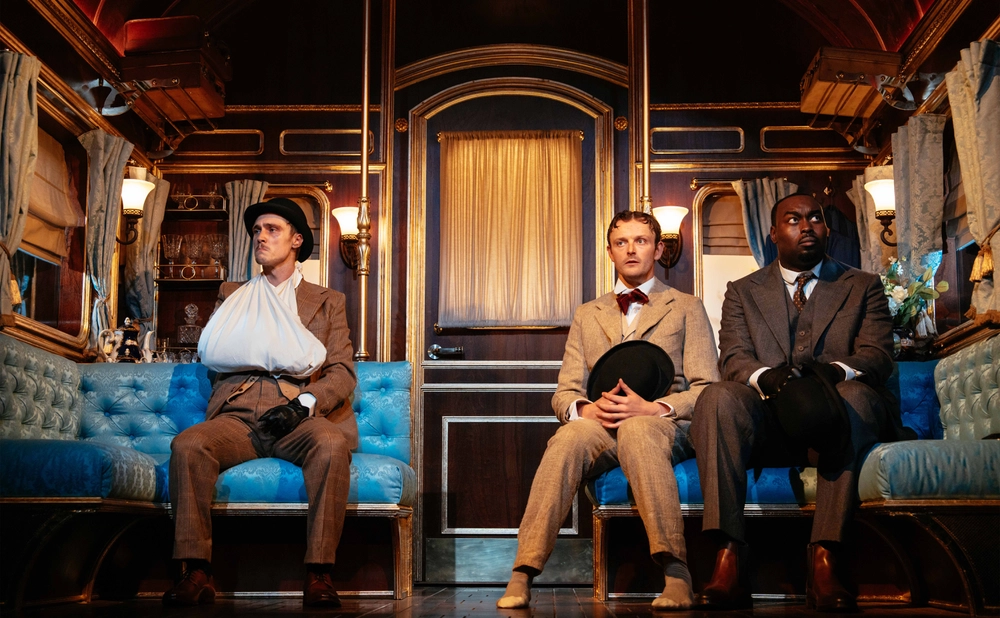
Three young men bump into each other in the depths of a Belgrade burrow. They’ve all been summoned by the Captain, a numinous military dandy with a silver tongue and taste for noble blood. Their mission is simple — they must erase the intrusive forces oppressing the unity and individuality of the Serbs. In other words, they must engage in terrorism. And giving up their lives is the small price to pay to honour a greater cause. And more importantly, for their names to be lauded and remembered forever.

If you’re hooked by this premise, you’ve got every right to. It is a good one. And its potential for an insightful societal comment is overflowing. Does it make it? Yes. Does it do it the right way? Not quite.
Structurally flawed, the amount of pointless exposition creates a sluggish rhythm that erodes- and eventually cracks -the initial interest its concept might have generated. There’s too much rambling. And although the plot keeps moving along, it’s often hindered by completely motionless sections with no other purpose than earning a few easy laughs through predictable, not-so-witty jokes.
At the same time, the script fails to supply the viewer with the tools to read through its subtext. And by doing that, it erases it entirely. Instead, its denouncement of misogyny and hurtful gender conventions- such as men’s worth being estimated by their will to sacrifice themselves and their physical integrity -is presented in such a flat manner, one might wonder if the author is actually playing with us by trying to convey the exact opposite. For the record, he isn’t — this is just overthinking, something he clearly hasn’t even bothered to consider.
The same lack of nuance affects the delivery of the story’s final act, which is hastily executed and exhibits next to no development. Although the characters undergo a decent transformation, as The Captain manipulates by validating the acts they are about to perpetrate, their eventual realisation is brought up too hastily and without sufficient buildup.

Consequently, the resolution feels hasty and deeply unsatisfactory. Once again, it reminds us of how much space has been wasted with pointless waffling, while crucial plot elements have been underwritten or totally ignored, resulting in what can only come across as dramaturgical ignorance.
Despite all these issues, there’s praise to be given. But that is primarily owned by the production. Both Es Devin’s superb set design, which brims with dynamism, intricacy, and atmospheric power, and Neil Austin’s eerie lighting concoct a menacing yet seductive universe, perfectly capturing and underpinning the show’s essence, while effectively making it look better than it really is.
Similarly, the company teems with organicness, rapport, and magnetism in their naturalist yet slightly stylised portrayals. Among them, Marc Wootton steals every scene with his energetic, highly charismatic performance as The Captain, whose buffoonish façade still allows audiences to see through his insidious true self.
It deserves a chance, nonetheless. But that should be given with the expectation of a deeply unpolished work, whose possibilities are clouded by a heavy-handed approach, although the quality of its germinal idea permeates to some extent. Despite some mundane segments, Archduke has a pulse, but it’s by no means strong enough to call this piece a coup.
Help us continue our work
We count on your support to keep bringing the greatest quality in theatre-related content, from interviews with the biggest names in the industry to reviews of every show in town and beyond.
We appreciate every donation to maintain our high pace and standards and continue to grow.
Thank you for believing in us!
***************************************************
All pictures credit to Helen Murray.
Archduke plays at London’s Royal Court Theatre until 25 July. Tickets are available on the following link.