
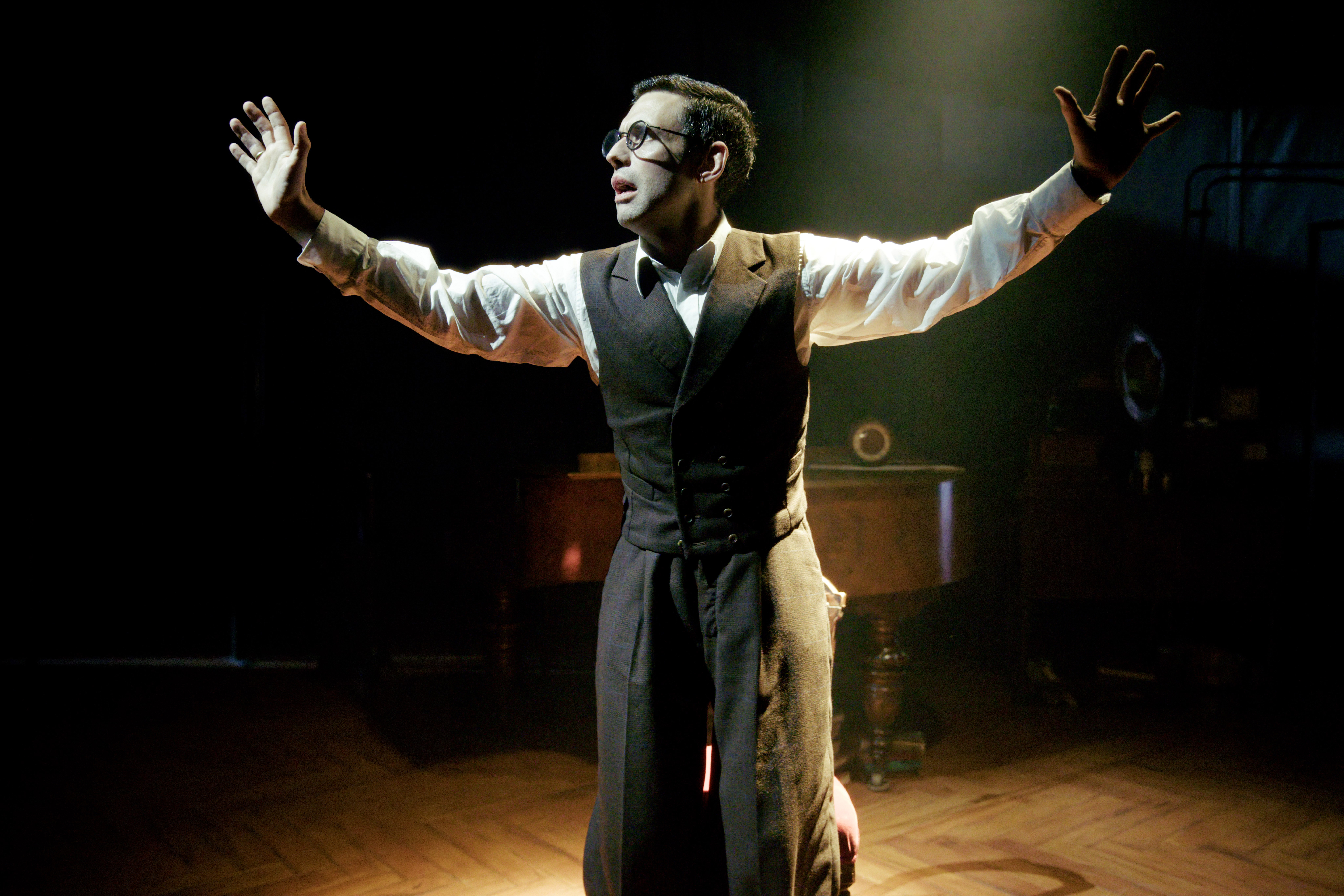
It’s difficult enough to sit through a two-and-a-half-hour play following a first-thing flight from New York for writers Rosalind Adler and Lea Sellers to make things worse. And worse, they make them — to a point where the tedium becomes torturous. Bear in mind that the plot is set during Stalin’s oppressive regime. But ironically, it’s not the characters but the viewer who, for the most part, has it harder.
There’s barely anything salvageable in Holy Fool, a piece exploring Shostakovich’s artistic struggles stemming from his strained relationship with the Soviet Union, and whose promising premise is betrayed- quite early on -by a totally inept script that shows as much depth as entertaining qualities; for clarification purposes, both of them are zero. And if this show has anything at all that builds even the slightest connection with its audience, it’s only its title — because it accurately describes how they’ll feel upon attending.
Harsh words, I know. Visceral, and perhaps a little too histrionic. All I can say is: what did you expect? If a show doesn’t give you the drama, you need to provide it somehow. That’s the main deficiency in Adler and Sellers’ writing: although they try to build conflict, there’s not much in the end — it lacks grip, development, and structure.

The story begins with a distraught Shostakovich at the premiere of his latest composition, frustrated by the orchestra’s inadequate precision. Soon he will realise that mistaking an F natural for an F sharp would be the least of his problems, as the impending criticism of his work (a newspaper article accuses him of counterrevolutionary ideas) will make him fall out of favour with the supreme leader — with the potential risks that it entails.
Fearing for his professional future and even his own life, he cancels the opening of his most precious creation, the Symphony No. 4 in C Minor, hiding the original score under the floorboards — perhaps forever. It would not be until a late reunion with a long-lost acquaintance challenges his decision to conform — and restores the courage and passion to be his true artistic self.
All those elements set the foundation for an engaging narrative and a compelling character arc. Sadly, those prospects never materialise. Overall, the script struggles to do anything other than present a few facts. There is no sense of journey — neither in its action nor in its introspection. Ultimately, the play doesn’t really go anywhere; the character’s strife is poorly explored, and despite the context, most events come across as dull and in need of additional tension.
Consequently, our investment in the recount is as insignificant as its resonance. We can’t care for the personages or their story, simply because there’s nothing to care about. The dialogue is shallow and blighted with clunky lines. The characters are equally one-dimensional and generally off-putting, as they’re all devoid of heart and humanity. And although the show wants to fool us (pun intended) into thinking that there’s been some growth or evolution (a content old Shostakovich proudly proclaims his magnum opus is at last finished), nothing of the kind actually happens — all that we’re given is flatness after flatness.

The actors do what they can with the material. Some portrayals are decent, with Benjamin O’Mahony arguably delivering the best performance as the lead — not very nuanced (not that the text offers many opportunities for that) but still competent and energetic. Similarly, Jenna Augen is somewhat magnetic and demonstrates versatility as both Shostakovich’s wife, Nina, and the rest of her roster. Wistfully, the same praise can’t be extended to either Fergus O’Donnell or Phoebe Pryce, both coming off flavourless and hardly believable in their multi-role renditions.
In a making-of interview, Miloš Forman recalled how he nearly missed the world premiere of Amadeus after hearing it was a play about composers, the sort of narrative communist countries love because those artists don’t denounce governments; they just write music. It’s baffling to see how a show whose premise directly challenges that notion ends up proving him right.
Eventually, Holy Fool is nothing but a superficial, unenticing, and painfully boring piece, whose only appeal is the name it intends to honour — and fails to do so miserably. Despite acknowledging the man’s uncompromising ear, the whole thing comes out extremely out of tune with its audience and even its own ideas. Vehemently, it tries to strike a chord but forgets no one would listen.
Help us continue our work
We count on your support to keep bringing the greatest quality in theatre-related content, from interviews with the biggest names in the industry to reviews of every show in town and beyond.
We appreciate every donation to maintain our high pace and standards and continue to grow.
Thank you for believing in us!
***************************************************
All pictures credit to Mark Douet.
Holy Fool plays at London’s Park Theatre until 10 October. Tickets are available on the following link.
One response to “Review of ‘Holy Fool’: “Shostakovich-themed play brings no harmony — but it doesn’t conflict either””
I agree. I was bored and everything seemed brought down to the lowest common denominator, feisty wife, no character development.