
They lied in the tagline. This isn’t a musical. I don’t mind the deception, however. If misleading the public means this show may get more viewers, so be it. Because it needs to be seen. And heard. And more importantly, listened to. Szpilman gave us the facts. Polanski gave us the images. And now, albeit unfinished, the stage has given us the experience. The kind that, sadly, currently resonates more than in the last few decades.
The plot needs little introduction. The horrific memories of world-acclaimed pianist and Holocaust survivor Władysław Szpilman offer a first-hand look into the barbaric acts committed against the Jewish population during World War II. The film didn’t hold back in portraying the events in all their crudeness. So much so that, ever since I came across the film over twenty years ago, I’ve been haunted by two sequences: one depicted a starving man tussling with an old lady over a can of food and eating its contents after it fell onto the pavement; the other showed a young boy trying to awaken his father’s rotting corpse.

Theatre’s conceptual nature lets the play break away from Polanski’s graphic brutality. Perhaps, deviating a little too much. Some of these moments are referenced throughout the script’s strong dialogue, but a symbolic, visual representation of these accounts will surely have struck a chord more resoundingly than the most vivid description could ever do.
That’s, however, a tiny flaw in a sea of dramaturgical competence. For the most part, Tom Sutherland’s writing demonstrates resourcefulness: it’s profound, fluid, gripping, and occasionally emotive. The pathos permeates the narrative adequately. We’re not shown a mere carousel of recollections, but also the protagonist’s own ghosts and demons: his identity struggles about what he was and who he is now, and the survivor’s guilt that’s become his lifelong companion following the death of his family.
Sutherland’s version delves into the character’s psyche by assigning him the role of raconteur. His take on the story makes it more intimate, treating the audience as confidantes while charting a clearer path into the role’s inner truth, which it accesses only partially: the themes are tangible and adroitly introduced, but none of them is expanded enough to build a convincing evolution.

Consequently, the bond with the viewer is established but not consolidated. That doesn’t mean we do not care about him; anyone with the slightest trace of humanity would, because of his heart-wrenching circumstances. But on a personal level, the character doesn’t feel that compelling. He leads an interesting life but doesn’t exhibit too many interesting traits, not because he doesn’t have them, but because they are barely explored. As a result, his relevance hardly stems from within.
Despite these shortcomings, Sutherland’s execution is striking enough and widely satisfactory. Overall, the narrative is well-paced, although slightly rushed at the end. At the same time, the tension is overpowering, making the entire performance highly absorbing. All the numbers are seamlessly integrated into the scenes, rarely moving the plot along (as musicals do), but still enhancing its sentimentality and entertaining qualities.
The play’s showstopper, an internal dialogue Szpilman holds with his brother after seeing him and his family depart on a death train, makes the only exception. It’s the right topic, but not the correct approach. The song maintains a serious tone, but for some reason, it doesn’t transfix. Its poignancy comes off as artificial. And rather than cathartic, the segment looks soap operatic — if not slightly camp.
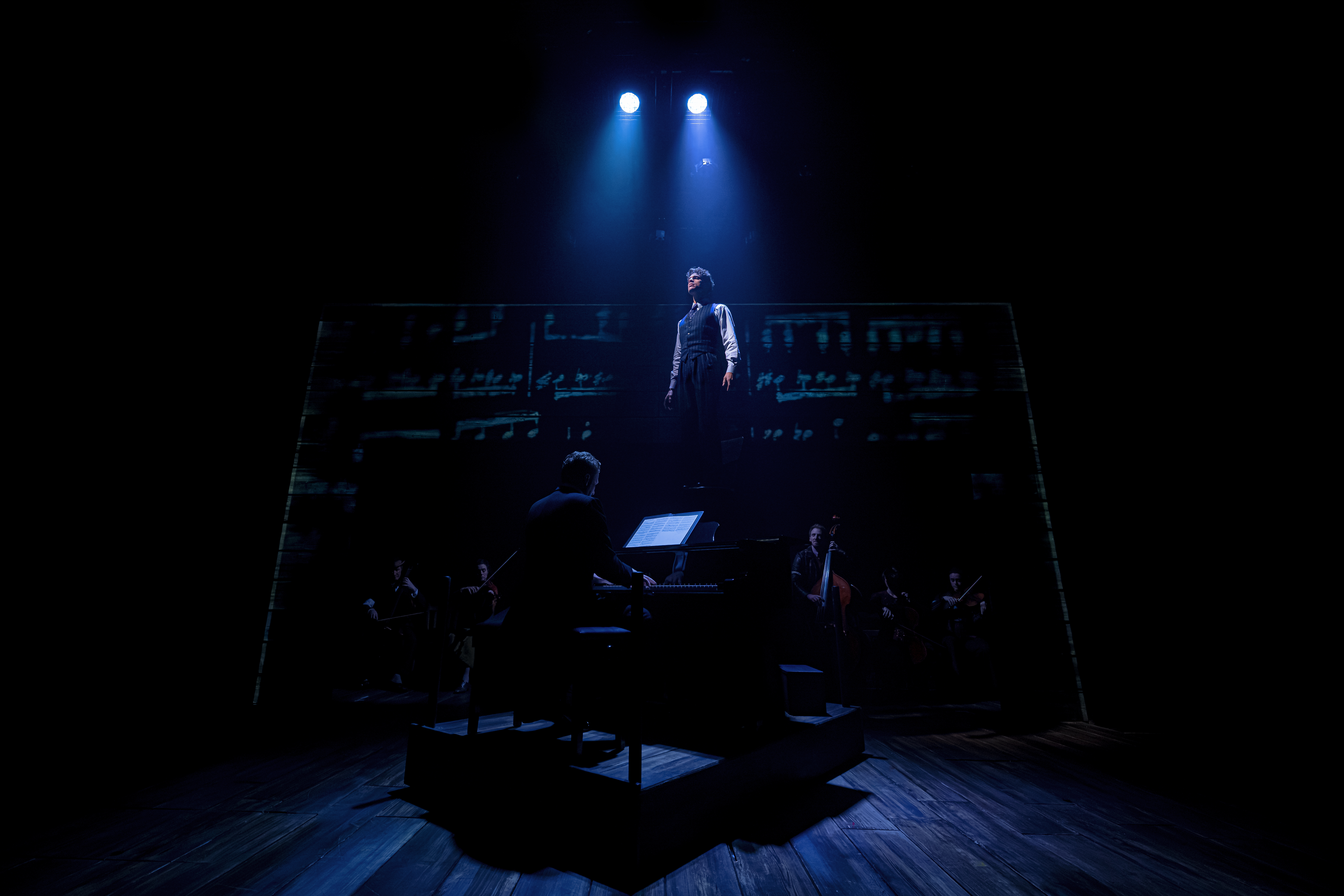
The production features a cast of multi-instrumentalists as its touchstone, a wonderful bonus that absolutely works to their advantage. Most performances are engaging, but their generally flawless vocals and superb skills on the strings and accordion are what make them genuinely impressive. Szpilman’s role is shared by a live concert pianist, serving as an abstraction of his musical soul and, ultimately, the big perk of this adaptation.

Daniel Krikler delivers a decent portrayal in the title role. Sadly, his rendition fails to capture the grief and scarring his character endures. One might argue his solemn attitude is deliberate, as it’s supposed to be the aftermath of deeply traumatising situations. Even if that were the case, it would be the wrong decision, as it limits the performer’s range and contradicts the personage’s arc: he can behave that way when acting as the narrator because his journey has already concluded; if he’s living those events, however, he needs to react accordingly.
The staging is another highlight of this production. Far from opulent (if not the exact opposite), the design relies on basic props and a cluster of sliding wooden walls to create all the settings. The result is refreshingly good: versatile, dynamic, and exceedingly evocative. It paints pictures with extreme accuracy despite the simplicity of its strokes, complemented by vibrantly elegant, detailed, and remarkably atmospheric lighting.
Polanski’s film took home three Academy Awards out of seven nominations. This version uses the same source material, but it’s not ready for that level of recognition. Still, the possibilities are there and within reach from where the show stands. As George C. Wolfe said once, “To make a show go from good to very good, it’s very easy. But to make it go from very good to brilliant, it’s an endless series of details.”
Help us continue our work
We count on your support to keep bringing the greatest quality in theatre-related content, from interviews with the biggest names in the industry to reviews of every show in town and beyond.
We appreciate every donation to maintain our high pace and standards and continue to grow.
Thank you for believing in us!
***************************************************
All pictures credit to Richard Southgate.
The Pianist plays at London’s Park Theatre until 28 November. Tickets are available on the following link.