
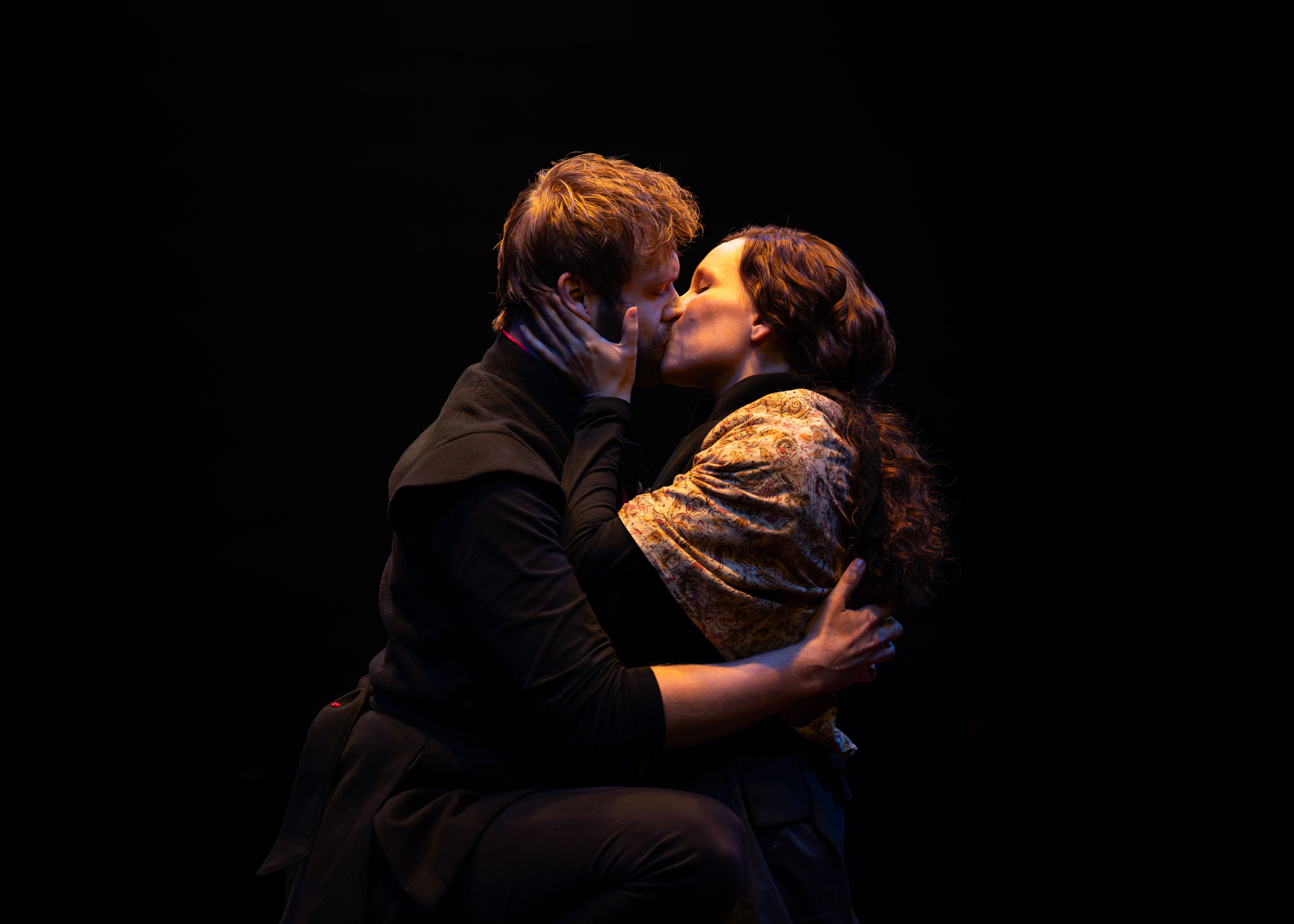
It’s never had its way with audiences. The original London production was indeed on for a good couple of years. But that hardly compares to the remarkable success of Boublil and Schönberg’s previous works. Had it opened today in its initial form, it probably wouldn’t have lasted that long. Neither will this newest, heavily altered iteration. Not because of its strictly limited one-month run, but because the story just isn’t strong enough. In fact, it’s weaker than before.
The real-life account of Martin Guerre is understandable inspiration for dramatists. A married man suddenly flees his hometown only to return eight years later (seven in the musical) to the incredulity of some of his peers. A dispute over an inheritance raises his uncle’s suspicions. And with the help of a few other conspirators, he brings him to court accusing him of not being the genuine Martin Guerre. A cross-examination follows, during which the alleged impostor provides remarkably accurate information about Guerre’s life. It seems the defendant is off the hook — until another man named Martin suddenly reappears.
The show’s original version deliberately overlooked several facts for narrative purposes. Overall, it was the right thing to do. Instead of presenting Martin’s identity thief, Arnaud du Thil, as the vicinal, opportunistic fraudster the historical one was, his fictional self befriends Martin during the war and is tasked with delivering the news of his death. Unable to break it to his spouse, he decides to supplant him after a couple of locals mistake him for Martin. A passionate romance develops, and themes of sacrifice, prejudice, and religious persecution are compellingly explored.

That isn’t the case in the Old Vic’s production, which condenses the action into a straight-through 90-minute journey of questionable tension and nonexistent depth. Its distinctive overture (with its famous sotto voce flute notes) has been replaced with a more traditional ensemble opening depicting a callous puritan society rooted in mistrust, contention, and a thirst for revenge.
Similar events unfold later: Martin is forced to marry Bertrande as a boy in a transactional affair to earn more land. Overwhelmed by a life he doesn’t want, he decides to run away. However, Arnauld chooses to take his name the moment his pal passes away. Dramaturgically, it makes little sense. There’s no motivation, and the script makes absolutely no effort to address it. The character introspection is barely present: no song delves into the protagonist’s psychology, despite the many possibilities his story offers and, more importantly, requires to work.
At the same time, the conflict is poorly executed. Although the recount features a few flashbacks, the general approach feels too linear and, above all, too hasty and shallow. Ultimately, the narrative has no room to breathe, resulting in a sketchy sequence of events that entertains adequately but doesn’t resonate, coming off as too melodramatic and not very moving.
Schönberg’s score preserves its signature lushness and tunefulness despite its limited originality. Although the music conveys its setting’s folk, early modern essence, the similarities with his previous compositions are too obvious to ignore: one section has the same chord progression and bass arrangement as Turning (a.k.a. Lovely Ladies); the recitative melody from Look Down is replicated during the family meal scene; the marriage duet sung by young Martin and Bertrande bears an uncanny harmonic resemblance to I Still Believe; and, if that wasn’t enough Miss Saigon for you, The Telephone Song is a cornerstone of the angry-mob number, The Deluge.
It’s widely enjoyable, nonetheless. That is, as long as you don’t pay much attention to the new lyrics. They aren’t terrible, but they don’t excel either. Most rhymes are too basic and somewhat predictable. In some instances, they also sound contrived: to make them work, the lines are crammed with unnecessary repetitions, which have no poetic impact and only highlight their artificiality and lack of inspiration (“you are not for me to own, the choice is yours and yours alone”).

The piece still benefits from Matthew Warchus’s extraordinary direction, which counterbalances the material’s flatness to some extent. His naturalistic approach makes the performances teem with truthfulness and raw emotionality, conveying a sense of documentary authenticity that’s both refreshing and striking. Furthermore, the use of a minimalist, in-the-round design imbues the act with dynamism, seamlessness, and theatricality while also achieving a decent degree of multiplicity.
Most of the company delivers a tour de force, primarily in the musical aspects. All the leads demonstrate impeccable singing technique. And eventually, their portrayals brim with rapport, sincerity, and gravitas. Among them, Liv Andrusier earns the highest praise for her heartfelt interpretation as Bertrande. In addition, Barney Wilkinson leaves an imprint as Barney Wilkinson, perfectly capturing the character’s ruthless essence with galvanising stamina and magnetism.
The only exception comes from Dan Hand’s deficient performance as Young Martin Guerre. Sharing the role with Alex James-Hatton, who embodies the personage’s adult version, neither his singing nor his acting impress. Overall, his rendition is wooden, and his unsupported voice struggles with the title song’s demands, occasionally cracking or going out of tune.
It’s always challenging to revive an unsuccessful work. The inaugural production underwent significant rewrites for a reason. So has this new one. And I can’t say they are for the better. Albeit visually enticing, Warchus’s take is unlikely to bring so many tears to the viewers’ eyes (removing that tune might have something to do with it). With a more pedestrian, much less insightful narrative, Martin Guerre is far from winning this battle, let alone its own inner war. After so many failed attempts, perhaps the only way for this show to find peace is by resting in it once and for all.
Help us continue our work
We count on your support to keep bringing the greatest quality in theatre-related content, from interviews with the biggest names in the industry to reviews of every show in town and beyond.
We appreciate every donation to maintain our high pace and standards and continue to grow.
Thank you for believing in us!
***************************************************
All pictures credit to Helen Maybanks.
Martin Guerre plays at London’s Old Vic until 31 October. Tickets are available on the following link.