
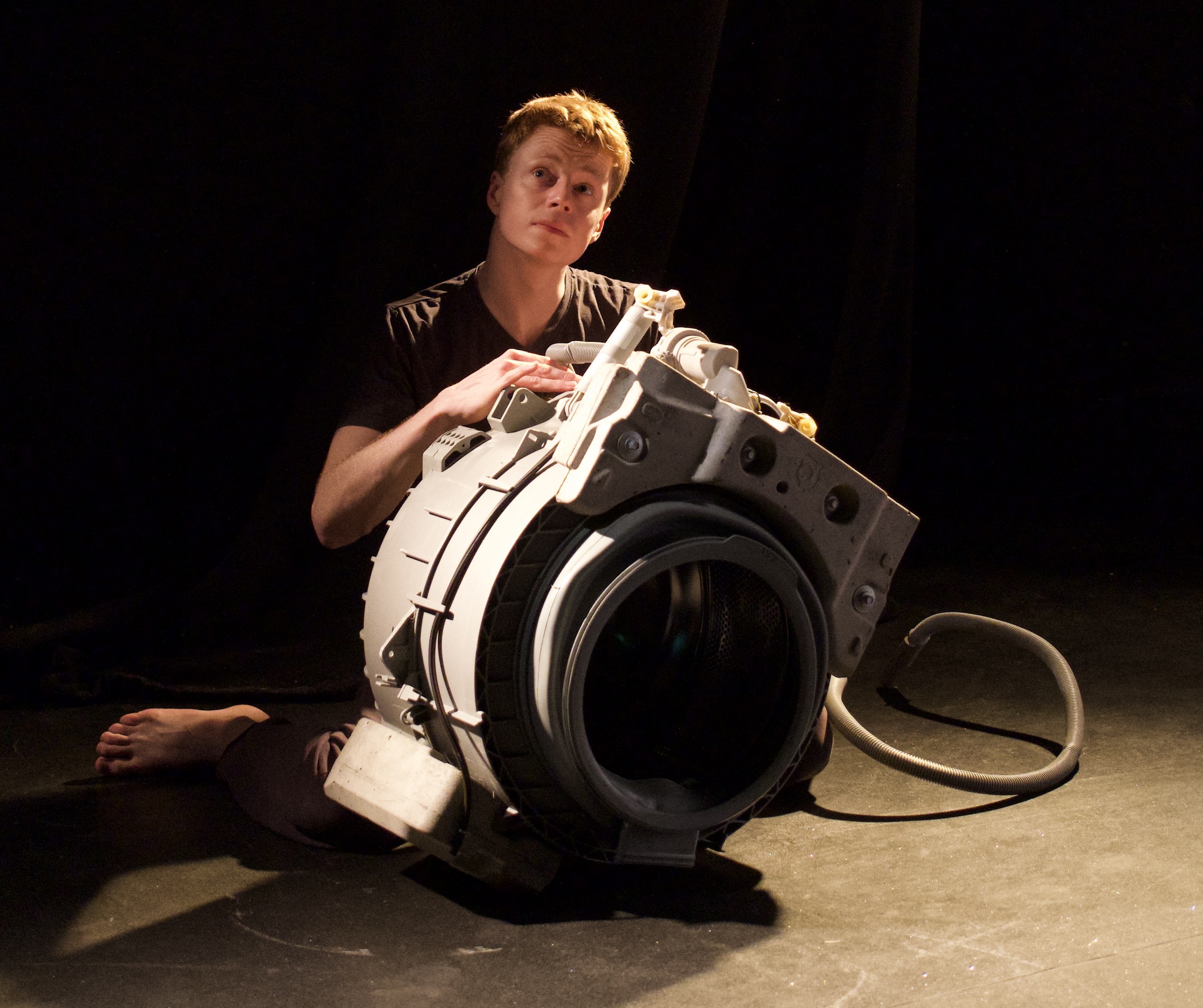
The Devised Theatre Company held last week the world premiere of their newest play – featuring unspoken scenes and a symbolic vision of the human condition. Guillermo Nazara shares his thoughts on the production, to let us know if this swirling whirlpool of ideas made his head spin-dry.
Life is a mystery. Thanks, Madonna, for making things clearer… Though that may be the only sharp thing that we can tell about our existence. From the day we arrive (the connection was inevitable, Tim) to the moment the sun sets in our journeys for the last time, we dwell in the realm of the unknown; wandering in a world we’ve built and are a part of – but even so, struggle to understand.
Giving answers to those queries has always been the main purpose of art. What’s the reason for our path? Where do we go from here? (now they’re both working in tandem! Oh… right…). Rarely do they provide us with a satisfying response to those questions. But even more hardly do we find plays that instead of exposing an idea, they just make us wonder: what’s that they’re really trying to ask?
Last week, the Devised Theatre Company blended into the bustling allure of Camden Town through the premiere of its new production, tumbling onto the fringe stage of the above-the-stairs pub venue The Etcetera. Titled A Man and a Washing Machine and directed by Moses Hao, the show features a laundry list of symbolism, but very little bleach to clarify. A fabric of vague messages and baffling images, its intended depth is however stained by a superficial approach – leading to a constant state of confusion as for what the piece attempts to evoke.
A clash between modernity and tradition? The loss of our own humanity for the sake of technological comfort? It’s hard to tell. Or even impossible, as the montage’s visually conceptual style (there’s not any form of dialogue or words whatsoever) serves more like a blindfold preventing us from seeing through. There’s obviously a message to be sent, and a goal to follow – but none of them ever reach their destination, since the play fails miserably at making any of its material compelling; let alone, communicative.

An open narrative can actually contribute to the success of a piece enormously. The problem arises when there’s not much of a storytelling that can be subject to the viewer’s interpretation. The duality between man and machine is established through its depiction (the titled also helped) – but unfortunately there’s nothing else that can be taken from its performance, apart from the picture of a boy contemplating his favourite house appliance. The attempts to create something profound and philosophical are obviously there. But the work is not sufficiently developed to come up with a proper theme. Instead, just a bunch of disorganized, incohesive concepts serve as the outliner for an almost non-existing structure – which, though apparently invisible, looks as if crumbling all throughout.
We come to the theatre to live through the eyes of others, and to feel through the hearts that beat close to ours. Every piece should be an experience. And every one is always an experiment. A Man and a Washing Machine has admirably taken a risk by constructing something incredibly daring. But wistfully, the formula has imploded almost as silently as its delivery.
Not everything is lost, though – as the show could be saved if repurposed in an immersive way. Non-traditional writing should be met by non-traditional staging. Imagining the play as a fine art exhibition, where every scene is presented as the snippets of a walk-through, could finally do the trick – and transform what’s unluckily turned out to be a dull, opaque montage into something exciting, meaningful and adventurous. A mad idea can easily be made sane by a madder companion. It’s only when we go crazy that things truly start to make sense.
All pictures credit to Mingjia Qu.